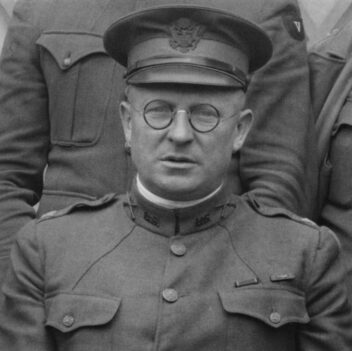
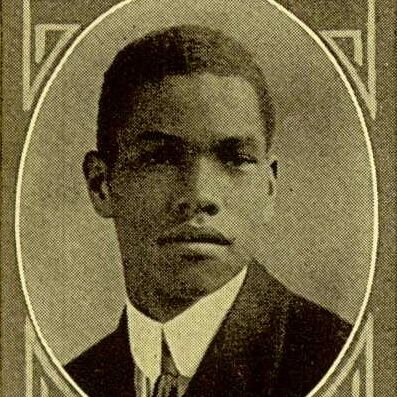
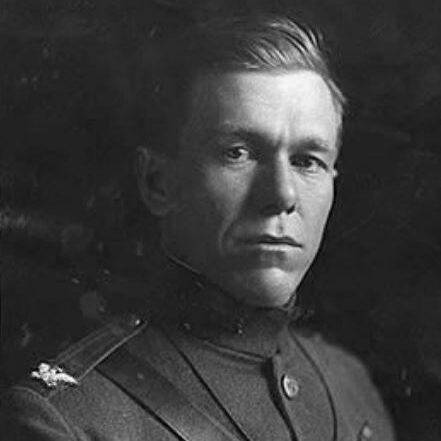
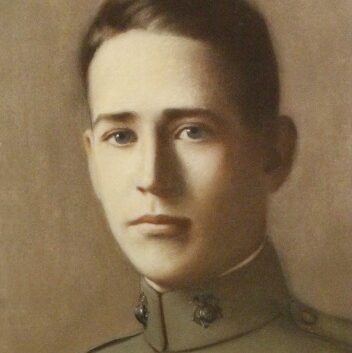
This educational website was created from a desire to learn more about World War I Read more
Lost Battalion Connection
George G. McMurtry Jr., a member of the 308th Infantry during WW1 was the recipient of the Congressional Medal of Honor. He is best known as being a member of the “Lost Battalion,” the millionaire stockbroker from New York, but he spent his youth on the Northside of Pittsburgh (Allegheny City). He was the son of a wealthy Iron Manufacturer and at age 10, the Pittsburgh Cyclorama Company built a large building only a few hundred feet from the McMurtry residence. It was a 360-degree mural displaying the “Battle of Gettysburg” and would have undoubtedly been a draw to the young McMurtry during his youth. This video gives a glimpse of the places McMurtry lived while he was in Pittsburgh.
Légion étrangère
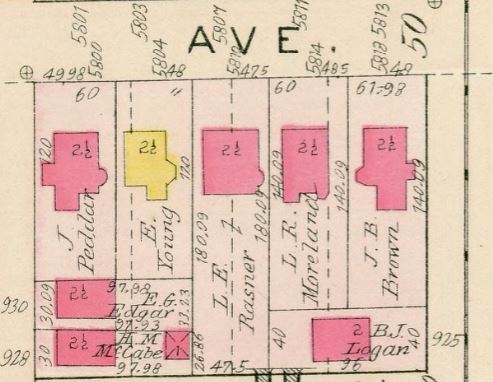
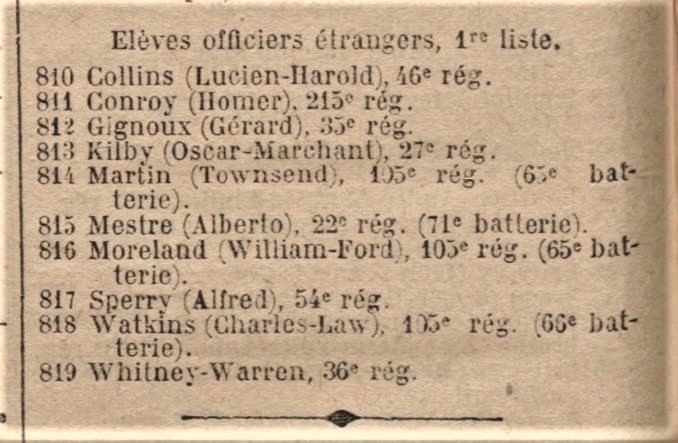
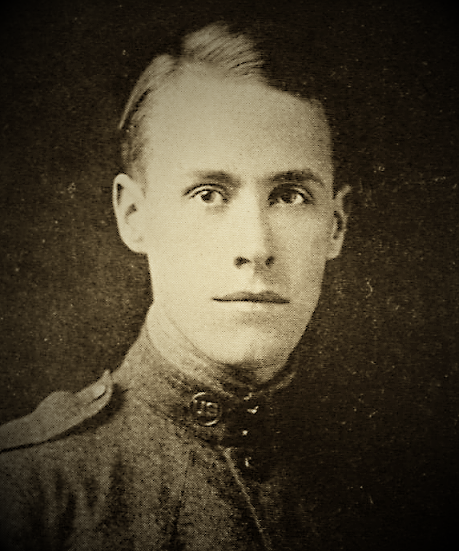
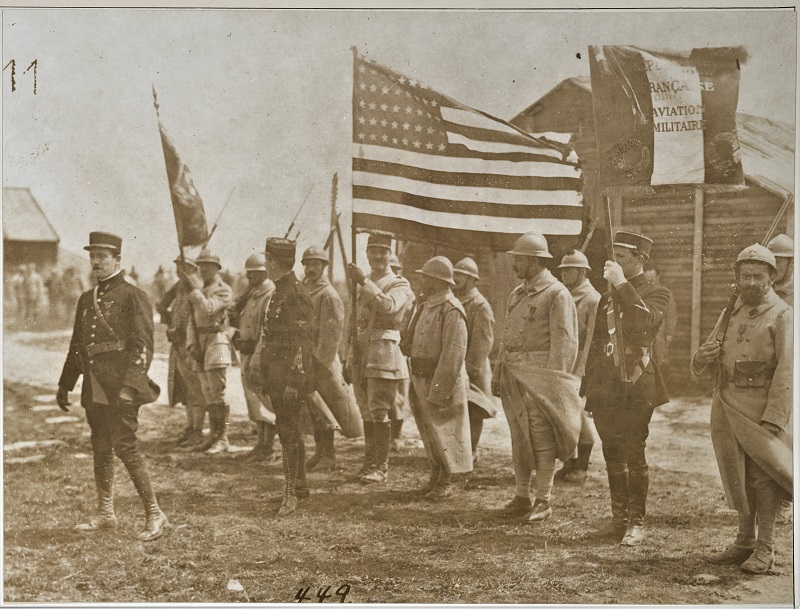
William Ford Moreland was yet another Pittsburgh veteran of the Great War who put himself at risk to assist the Allies before the United States even declared war on Germany. While Moreland survived several battle engagements and returned home, he died prematurely at the age of 36 years as a result of the lasting effects that the war had inflicted upon him. Moreland, who went by the name “Ford” by friends and family, was the son of a prominent Pittsburgh family. He was studying at Yale University, New Haven, Connecticut when the war started in Europe. He left the United States to assist as a volunteer with the American Field Service and ultimately worked his way into fighting alongside the French. The Moreland family lived in the present-day Highland Park neighborhood of Pittsburgh.
After the war, he was well known to other veterans of Pittsburgh, such as Colonel Joseph H. Thompson, the state commander of the American Legion, who asked Moreland to be one of his personal aides when Marshal Foch planned his visit to Pittsburgh in November 1921. I’ve included an article here that appeared in the Pittsburgh newspapers that described Morleand’s experiences and have included some photos from the time period that are appropriate to the story. The following article was written by Charles J. Doyle in Paris, December 7, 1918, as a special correspondent of the Pittsburgh Gazette Times while in France.
HEROIC PITTSBURGH BOY BRAVES DEATH TO STOP HUN HORDE – Lt. Moreland’s Remarkable Gallantry Wins Croix de Guerre with Star and Enviable Place in Ranks of Famous Foreign Legion.
Of the many stories of Western Pennsylvania youths who rushed to France to fight with her for the noble cause of world liberty, which have been coming to light since the war ended, none is more interesting or varied in episode than that of young William Ford Moreland of Pittsburgh, whose father is secretary of the Jones & Laughlin Steel Company. Young Moreland is a lieutenant of artillery in the far-famed Legion Etrangere, or Foreign Legion, of the French Army. He wears the insignia of the Croix de Guerre and star for valor, the decoration having been bestowed upon him in the field by Marshal Petain, at the time commander of all the French armies.
Lieut. Moreland is the youngest officer by several years in the artillery unit to which he is attached, and has been in more battles and swifter action and tighter places and through greater hardships than most other young men of the United States who valorously came to France to help her fight off the Hun horde. His story was told to me by some of the other young Americans here, who know his record, which is said to be unusual and which France has recognized by several decorations.
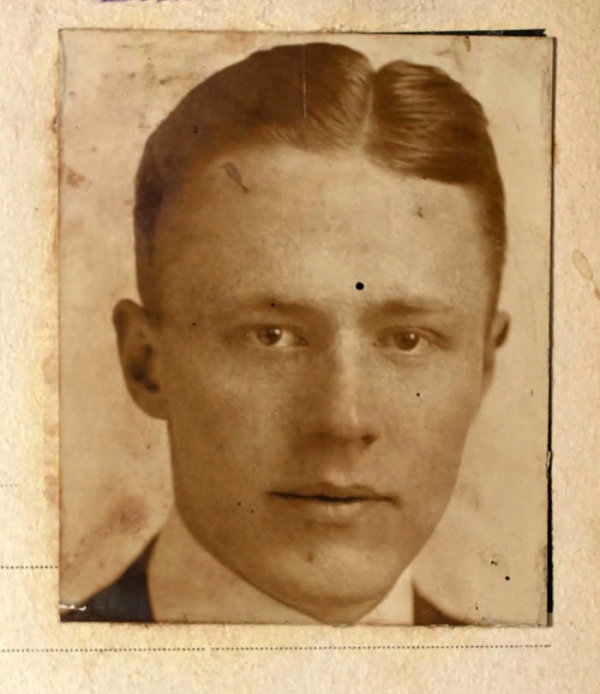
As soon as war was declared between American and Germany young Moreland, then a student at Yale University, started out to get into Uncle Sam’s fighting forces and be sent over here. As he was not yet 20 years old, he was unable to enlist in any officers’ training camp of the American service in any capacity, although he tried them all. However, he came to France with the American Field Service toward the end of June, 1917, enlisting to drive an ambulance or transport.
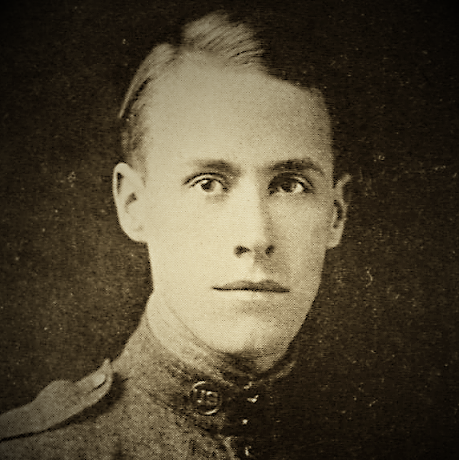
William Ford Moreland AFS photo c1917
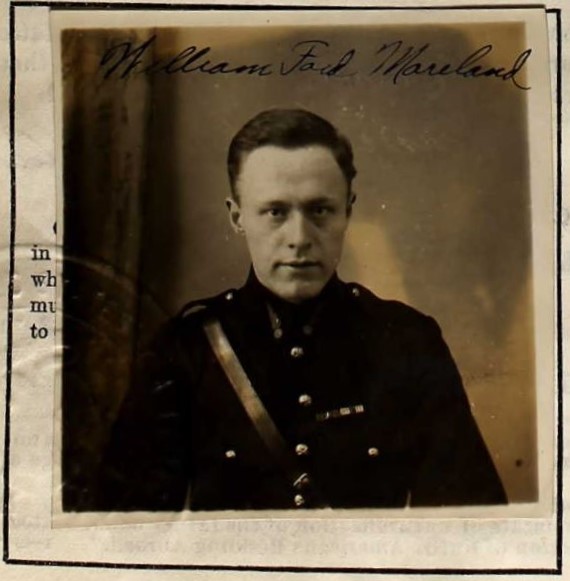
William Ford Moreland Passport photo c1919
After he got here and looked around, he decided that he would see more action and be of more service by joining the French Army transport, which he did. He was sent to a training camp and engaged in a short while as a full-fledged driver, or “conducteur,” of a five-ton French Army truck. Moreland’s company was sent to supply the famous French 75s in the artillery duel on the Verdun and Champagne fronts, and it was while so engaged that he received his first citation for courage in going to help serve a gun which had become shorthanded by reason of casualties during the action. His work with the transport service, hazardous and hard and frequently under fire, brought him in contact with the artillery at the front and caused him to determine to get into that branch of the French service.
Leaving the transport, he enlisted in the French artillery as a private, but was shortly taken out and sent to the officers’ training school at Fontainebleau, near this city [Paris], where he trained for artillery aviation. He passed successfully the severe tests of the school and was sent to train for the flying service. Just as he had completed his training as an airman volunteers were called for in the new French tank service and Moreland stepped forward. However, before he could be fully trained for this branch of the service he was selected on merit for the artillery of the Foreign Legion, and from the moment of joining his battery was engaged in action, which continued up to the signing of the armistice with little respite. The battery to which he was originally assigned was decimated in one of the great West front battles and Moreland was transferred to another command, which was badly used up in the closing engagements of the war, losing nearly all its horses and sustaining heavy casualties among officers and men. From the start of the great Allied offensive which brought end of the war Lieut. Moreland’s battery was at the front, following closely after the advancing infantry to furnish barrage fire and obliterate enemy trench systems and repel counter-attacks.
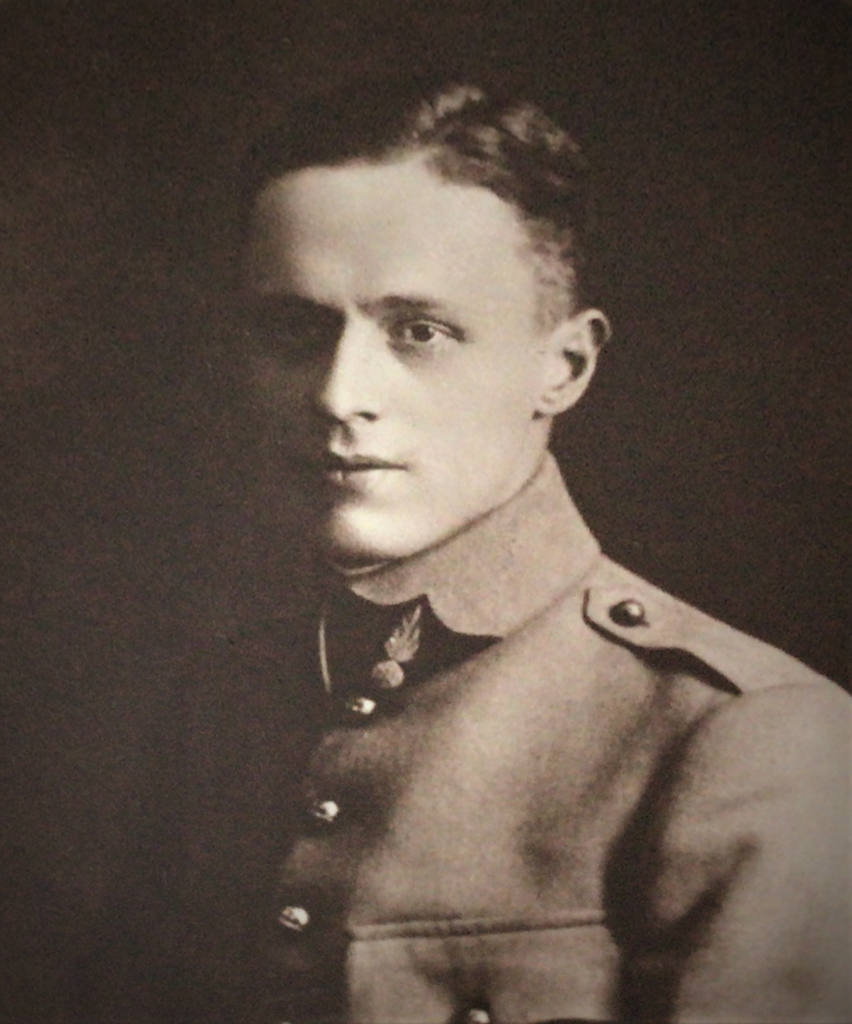
William Ford Moreland (photo courtesy Leslie McInnes)
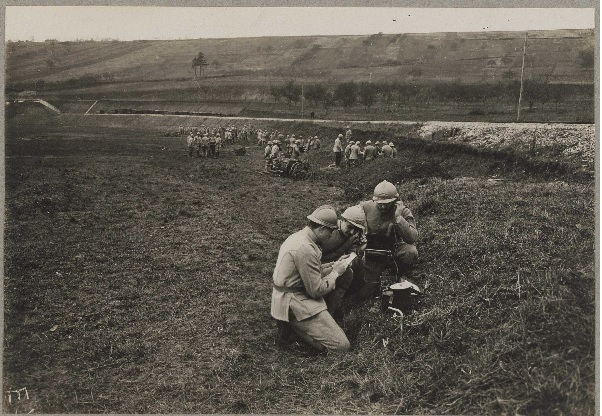
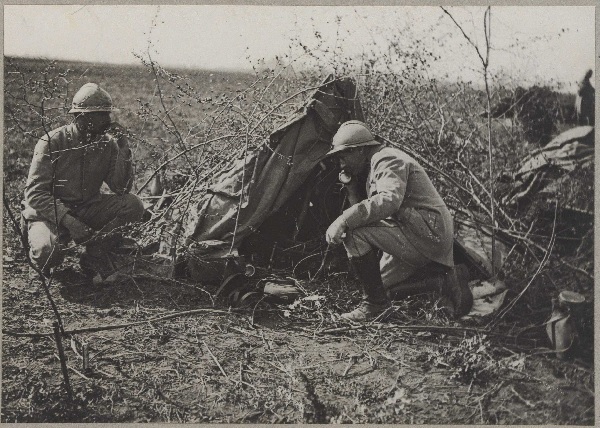
DECORATED FOR BRAVERY The act for which Lieut. Moreland was decorated in the field was one of exceptional coolness and deliberate sacrifice. His work of acting as barrage officer obliged him to go forward with the infantry to direct the barrage fire so that it remained always in front of the troops. This was done by means of a telephone mounted on wheels and required quick thinking and accurate calculating in order to avoid the catastrophe of the infantry rushing into its own barrage and also to prevent the enemy from coming through it.
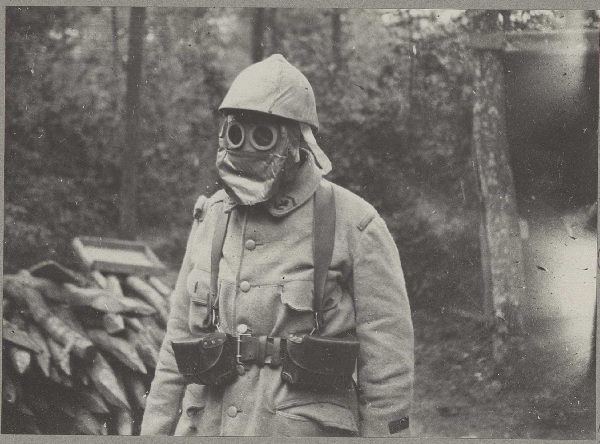
On the occasion mentions Lieut. Moreland was far out ahead with the first saves of infantry going forward in a heavy field of gas. Suddenly he saw a mass of enemy troops arise out of the trenches only a few hundred yards away and start forward in counter-attack. Quick work was necessary to alter the range of battery fire and check the attacking wave of Huns. He tried to give directions over the telephone, but the difficulty of making himself understood through the gas mask was too great. Instantly and deliberately, he removed the mask and transmitted the proper orders. He managed to get the mask on again, but succumbed to the gas. The advancing French found him unconscious and removed him to a dressing station. Here he was brought around and sent back and finally ordered up to this city on furlough to fully recover.
COMMAND IS SAVED Official records show that, as a result of Lieut. Moreland’s prompt and heroic action in risking his life to save his comrades, the battery was able to lay down a heavy barrage on the Huns within eight seconds after his telephone message got in and the attack was completely checked. For this deed of coolness, he was awarded the Croix de Guerre with star, which indicates a double award, and had the further distinction of having it pinned on his breast before the troops by Petain.
At the time this occurred Lieut. Moreland was a lieutenant aspirant, but having notable passed through the probationary period has since been promoted to a lieutenancy. His experience in the Great War just ended has been that of many other clean, courageous, high-minded young Americans, but few of them have been privileged to serve with the French artillery in the world-famous Foreign Legion and fewer still have been in as many battles and experienced as many exciting adventures with accompanying thrills.
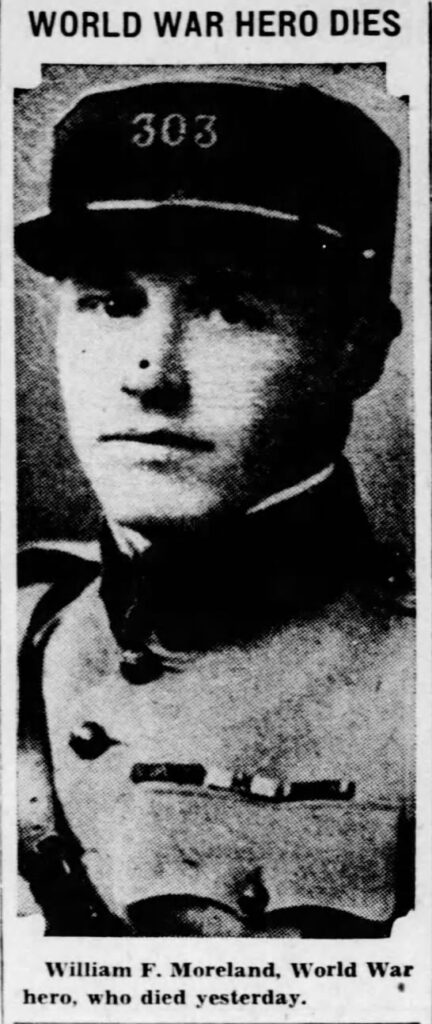
WILLIAM FORD MORELAND, HERO OF WORLD WAR, DIES HERE – Dared Effects of Poison Gas To Direct Fire That Saved Comrades – this article appeared in the Pittsburgh Press on February 27, 1933.
Legionnaires Mourn – Moreland was Honored by French Government With Special Croix de Guerre. The French Foreign Legion has lost one of its most gallant heroes in all its reckless history with the death of William Ford Moreland. Vice president of the Interstate Iron Company, a subsidiary of Jones & Laughlin Steel Corporation. Mr. Moreland, whose distinguished war service amounted to a brilliant record overseas in the World War, died yesterday after an operation. In France there are scores perhaps hundreds of Legionnaires who will mourn his death, for they owe their lives to the heroism of the Pittsburgher during one of the major Allied offensives.
Honored for Heroism – After this deed Mr. Moreland one day stood in a field before his comrades in arms, who cheered as the French leader, Marshal Petain, pinned on his breast a French Croix de Guerre. There was a star on that medal, indicating a double reward. “Deliberate sacrifice and exceptional coolness” such was the description of Mr. Moreland’s action which saved a group of French infantry from German bayonets and guns. As a member of the French Foreign Legion, Mr. Moreland at the time was a “barrage officer.” His duties were to go ahead with the first waves of the infantry to direct artillery fire.
Germans Surprised – The French shells were falling a few hundred yards ahead of the advancing French. Suddenly out of a trench hundreds of Germans appeared ready for the counter charge. Gas shells were dropping all around. The French fire was falling beyond the Germans. Mr. Moreland had to notify the artillery battery to change its fire to stop that counter charge. But how? Poison gas was all around him. He was wearing his mask. He could not talk into a field telephone-mounted on wheels while he had that mask on.
He ripped off the mask and gave the news through the phone. The French battery immediately poured a deadly barrage on the Germans and stopped their rush.
Pittsburgh Press (Pittsburgh PA) February 27, 1933
Found Overcome on Field – He ripped off the mask and gave the news through the phone. The French battery immediately poured a deadly barrage on the Germans, and stopped their rush. French infantry found Mr. Moreland overcome beside the field telephone the receiver in his hand. He was hailed immediately as a hero who had risked his life so save his fellow soldiers. Not yet 20, and while a student at Yale University, Mr. Moreland went to France with the American Field Service, and enlisted in the French Ambulance Corps because his youth barred him from enlisting in an officers’ training camp in the United States. He joined the French Army transport, and was sent to a training camp at Fontainebleau. Next, he was driving an ammunition truck in the great offensives at the Verdun and Champagne fronts. He was cited for courage when he manned a service gun, short-handed by casualties.
An example of the French gas mask Moreland would have had to remove to get the message through.
Made Lieutenant – He then joined the French artillery as a private, fighting in all major offensives until the Armistice. He was made a lieutenant soon after he became an artilleryman, in the Foreign Legion. Mr. Moreland was born in Pittsburgh in 1896, and attended Shadyside Academy and the Hill School as preparation for Yale. He entered the Yale class of 1913.
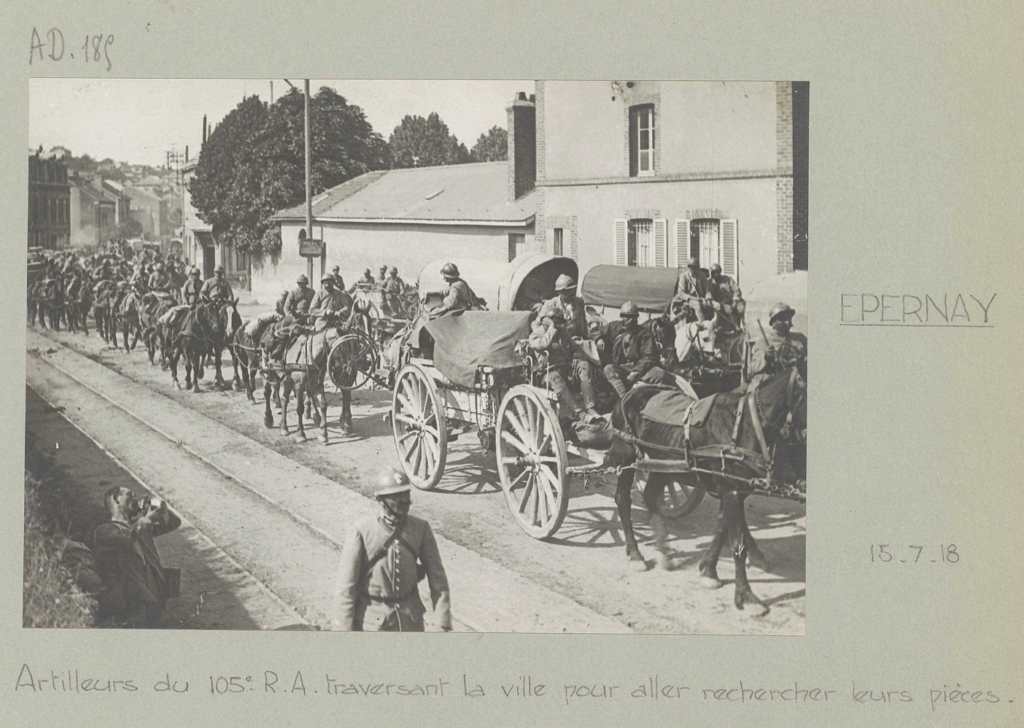
The 105th Artillery Regiment passing through Épernay, France on July 15, 1918. (Valois album).
Rises in Industry – On his return from the war he went to Virginia City, Minn., for two years as the representative of Jones & Laughlin at the iron ore mines. Then he returned to Pittsburgh, and was finally made vice president of the iron concern. His father is secretary of the corporation. Mr. Moreland is survived by his widow. Mrs. Helen Snow Moreland; two children. Barbara and William Crawford Moreland III; his parents, Mr. and Mrs. William C. Moreland; and a brother, Raymond Ford Moreland, Pittsburgh attorney.
The Pittsburgh Press (Pittsburgh, PA) Feb 27, 1933. p.28
Mestrovich On Point
Article reposted with permission by the author: Sergeant First Class Aaron L. Heft, USA
Mestrovich, who often went by the name Jack, was born Joko Meštrović on 22 May 1894 in what is now Montenegro, immigrated to the United States in 1911, and eventually settled in California with his uncle and brother. He was a well-known member of the Serbian community in Fresno and worked as a bookkeeper and auditor. Mestrovich later found employment at several hotels in California before eventually making his way to the “Steel City” of Pittsburgh, Pennsylvania.
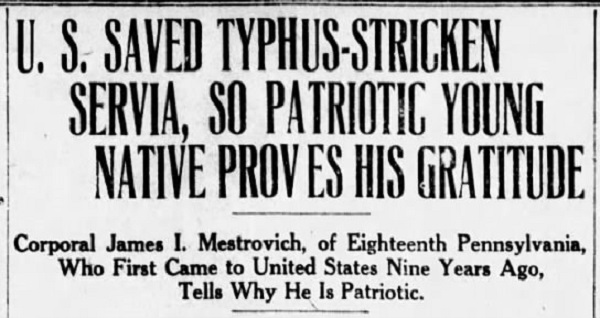
In 1914 Serbia and much of the Balkans were facing a pandemic much like today. In this case, it was typhus that swept through the region, beginning in camps of the Serbian Army and, in turn, spreading rapidly through the civilian populace. Back in the United States, growing concern about the Serbian people’s fate led aid organizations to begin deploying to the region. A group of volunteer doctors and nurses assembled in the United States through the Red Cross to provide critical medical personnel to Serbia. Mestrovich joined the delegation as an interpreter and spent fifteen months in Serbia on the pandemic’s front lines. While there, Mestrovich witnessed the typhus outbreak and the horrors of modern warfare. In addition to his linguist duties, he assisted his fellow countrymen wounded on the battlefield. Mestrovich once aided a Serbian captain and famous Belgrade professor who later visited him back in Pittsburgh while the captain recuperated there in 1917. American members of the Red Cross did all they could for the Serbian people. In the process, the majority of the group was infected, with a third of the American surgeons and many of the nurses in the group giving their life to aid the Serbian people.
El Paso Times (El Paso, TX) September 24, 1916, p. 15
Mestrovich returned to his newfound homeland after the Red Cross mission with a growing sense of patriotism. He told a reporter, “Before I went back home with American Doctors and saw the loyalty with which they served humanity did I (sic) understand the meaning of Americanism.” Upon returning to Pittsburgh in 1916, Mestrovich marched to his local recruiter and joined Company C, 18th Infantry, Pennsylvania National Guard—commonly known as the 18th Pennsylvania Infantry. “After the Americans did this for my people, maybe you can understand why I am in the National Guard. I left a good job as a bookkeeper at a hotel in Pitts- burgh to serve my country’s savior. I am ready for any service the United States has for me.” His country would be calling soon. In June 1916, Mestrovich’s unit was mobilized to serve along the U.S.-Mexico border in support of Regular Army operations in Mexico to apprehend the Mexican revolutionary Pancho Villa. The regiment promoted the young immigrant to corporal after he showed his military experience gained with the Serbian Army in his younger years. While the border operation offered Mestrovich an opportunity to serve his nation, the United States soon mobilized his regiment for a much bigger operation.
On 13 April 1917, one week after the United States declared war on Germany, the 18th Pennsylvania Infantry was called up for federal service to guard vital wartime industry in western Pennsylvania. A short time later, the men of the 18th Pennsylvania Infantry found themselves shipped to Camp Hancock near Augusta, Georgia. Here, the Pittsburgh Regiment joined the men of the 6th Pennsylvania Infantry from Philadelphia and sur- rounding counties to form the new 111th Infantry Regiment, which was assigned to the 28th Division. Mestrovich was not the only foreign-born soldier in the regiment. In Mestrovich’s Company C, the roster included other immigrants like Private Vincenzo Ferranti, who enlisted in the National Guard in Philadelphia but was born in Istrocsso, Italy, or Private James Jablonsky of Poland, who joined the National Guard in Pittsburgh. Many men who left their place of birth for end- less opportunity in the United States felt a similar call to arms and joined the Army as Mestrovich had.
After training in the United States, Mestrovich and the rest of the 28th Division, under the command of Major General Charles H. Muir, set sail for France from Camp Upton, New York, in the spring of 1918, with the last elements of the division arriving in France via England on 11 June. Now assigned to the American Expeditionary Forces (AEF), the 28th went through a brief period of training with French troops before being rushed to the front in response to the German offensives in the spring and summer of 1918.
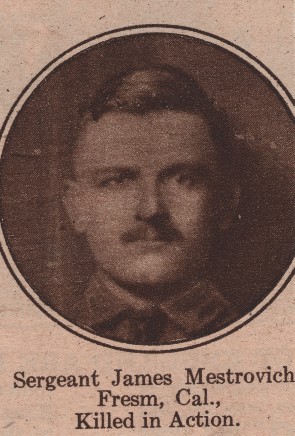
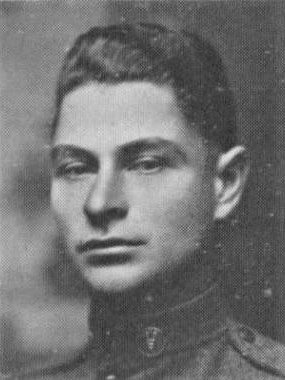
This portrait of Sergeant Mestrovich appeared in the book, Heroes of the World War, (1920).
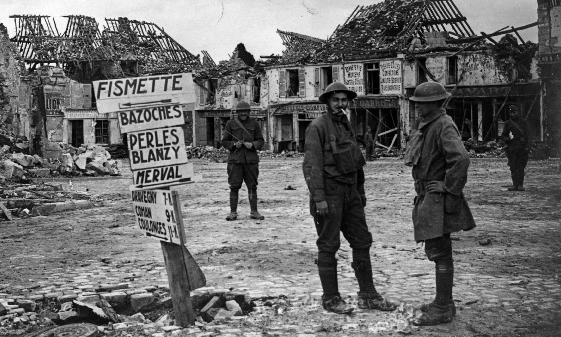
Fighting in France, the 28th Division earned the nickname “Men of Iron” for their dramatic stand at the Second Battle of the Marne in July 1918. For Company C and the rest of the 111th Infantry, it would be another fight, the battles for the French towns of Fismes and Fismette, where the men would truly be tested. On 9 August, the soldiers of the 111th relieved the 112th Infantry, which had suffered heavy casualties holding the bridgehead on the southern bank of the Vesle River at Fismes. Some of the companies filtered across the bridge into Fismette itself, on the northern bank. In Fismette, the men of the 111th occupied basements and cellars, fighting from concealed positions as German artillery and machine-gun fire raked the streets. As one lieutenant in Mestrovich’s battalion recalled, “We arranged a regular system of reliefs, the men taking turns on the line, then in the dug-out. To crawl out onto that line among the dead men by the wall in the tense darkness, shells whistling and falling, and now and then a flare of a corpse-like light, was a terrific test for a man.”
Soldiers of the 111th Infantry Regiment stand by a signpost in the ruined French town of Fismes in August 1918. (National Archives)
It was here in the hellscape of Fismette that Mestrovich, now a sergeant, forever cemented his name in history. On 10 August, Mestrovich saw his company commander, Captain James Williams, fall wounded as the company moved through the ruins of the town.
Without regard for his own safety, Mestrovich charged forward through a hail of machine-gun fire and falling artillery shells to rescue Williams and carry him to a concealed position to provide life-saving first aid.
Medal of Honor Citation
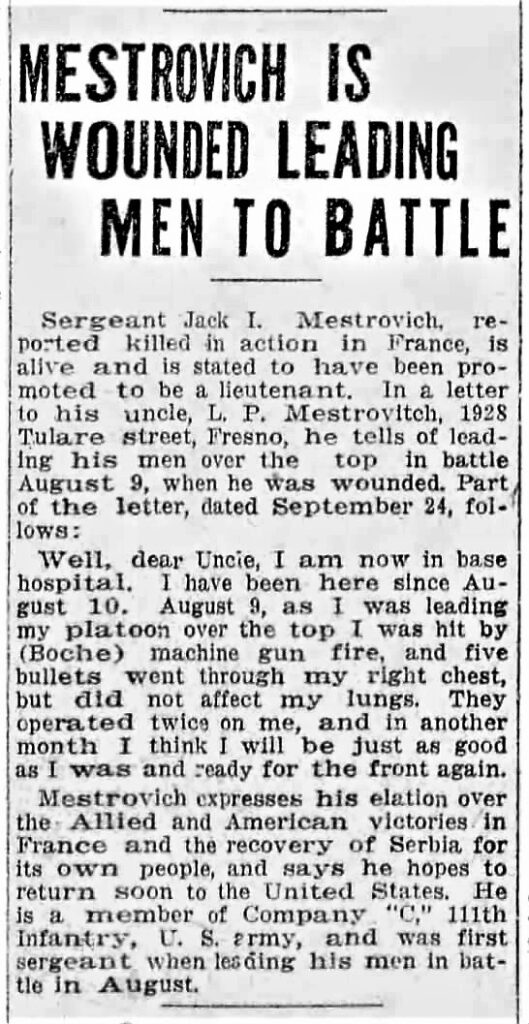
Without regard for his own safety, Mestrovich charged forward through a hail of machine-gun fire and falling artillery shells to rescue Williams and carry him to a concealed position to provide life-saving first aid. For this action, he would become the 28th Division’s first Medal of Honor recipient and one of only 121 soldiers to be awarded the medal in World War I. In rescuing Williams, Mestrovich was seriously wounded and initially reported as killed in action. He wrote to his uncle back in Fresno to tell him of being hit by machine-gun fire and recuperating in the hospital, stating, “They operated twice on me, and in another month I think I will be just as good as I was and ready for the front again.”
The Fresno Morning Republican (Fresno, CA) November 8, 1918, p. 4
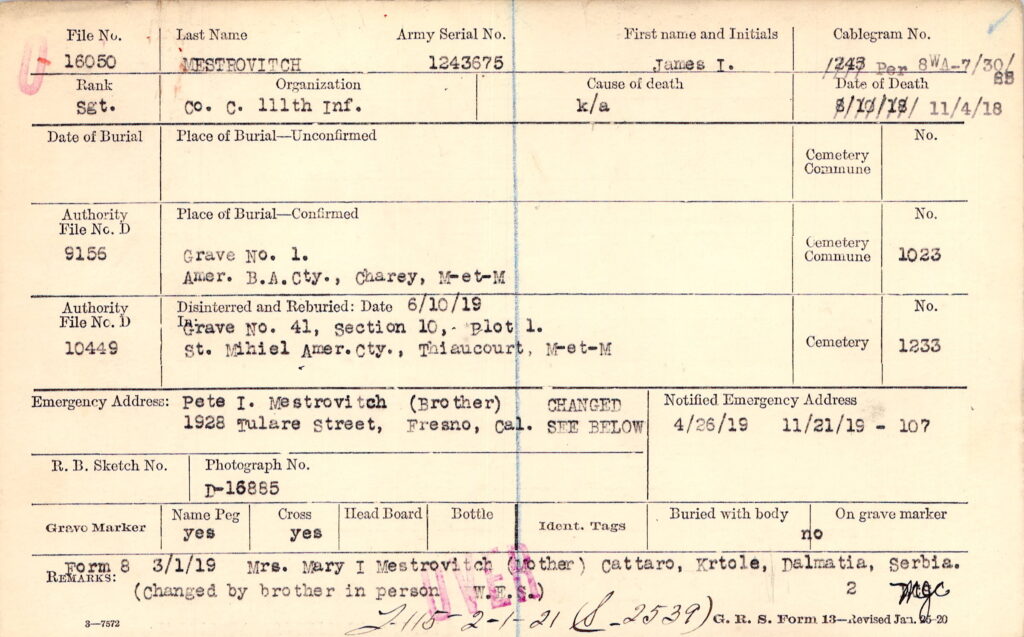
Mestrovich did recover and return to the 111th Infantry, but he would not survive the war to receive recognition for his heroic deeds in the streets of Fismette. As the fighting raged in the Meuse-Argonne, Sergeant Mestrovich fell in action on 4 November 1918 with nearly fifty other men from the 111th when their battalion came under fire from a concealed machine-gun position during a reconnaissance patrol only one week from the end of the war.
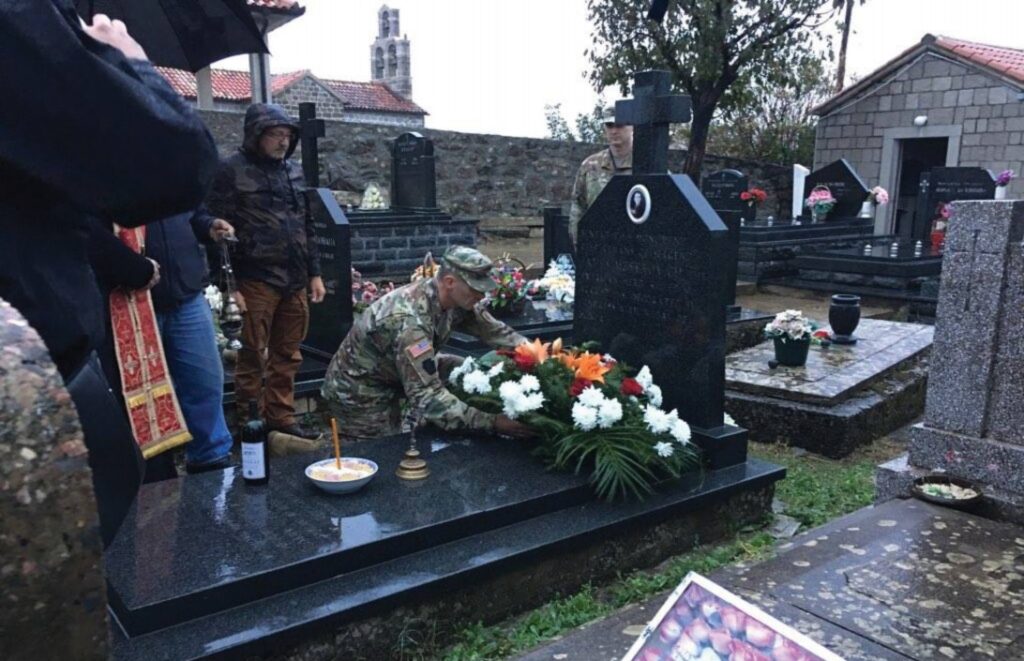
After burial in a temporary cemetery in France, Mestrovich was returned home to his mother in 1925 in the town of Boka, Yugoslavia, now in the nation of Montenegro. That same year the U.S. mission to Split visited Mestrovich’s mother and presented her with his Medal of Honor in the presence of a full honor guard. Mestrovich, who had been inspired by the American doctors who traveled to his homeland to provide aid, joined the National Guard to serve his adopted country. In its moment of need, he courageously gave his life in the pursuit of American ideals. Though buried in his homeland of Montenegro, his spirit and patriotism live on in the record of the 111th Infantry and show the real contribution of so many “new Americans” in the AEF during World War I.
Major General John L. Gronski, deputy commander of U.S. Army Europe, lays a wreath at Mestrovich’s grave during an official visit to Montenegro, 1 November 2018. (Joint Force Headquarters, Pennsylvania National Guard)
This article first appeared in the December 2020 issue of On Point The Journal of Army History, titled “Soldier: Sergeant James I. Mestrovich”
Pittsburgh Star of County Down
Joseph H. Thompson (1871-1928) was a World War 1 recipient of the Congressional Medal of Honor. He immigrated to Beaver Falls, PA (Western PA) from County Down, Northern Ireland, and earned degrees from both Geneva College in Beaver Falls, PA, and the Western University of Pennsylvania (University of Pittsburgh). He served with the 110th Infantry, 28th Division during the Great War, wounded four times, earning the Distinguished Service Cross for his actions on October 1, 1918, his citation later upgraded to the nations highest valor award, the Congressional Medal of Honor. This video highlights some of his accomplishments and also points to resources for anyone interested in researching the service of a World War I veteran. Links to sites highlighted in the video: Weldon Hoppe’s AEF Resource WWI Burial Card Project: http://wjh.us/aef/ Mike’s podcast Battles of the First World War https://www.firstworldwarpodcast.com/ Doughboy Foundation: https://doughboy.org/index.php
Pittsburgh Buffalo Soldier
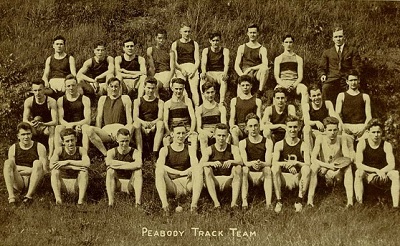
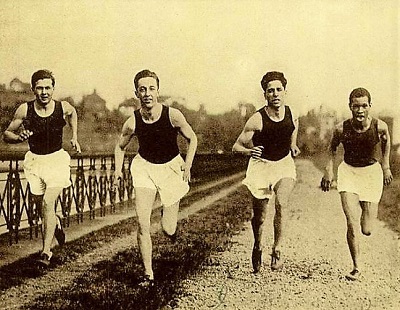
While researching the history of Francis Hogan for Poet of the Future, an article about a Pittsburgher killed in action during the Great War, I happened upon a man who graduated from Peabody High School the year prior to Hogan’s graduation. The photo of a young man caught my attention as I browsed the 1915 Peabody yearbook looking for other references to Hogan. This young man was John Fountain Barnette Jr, and he stood out as being the only African American man pictured in a couple of school track team photos and was the only African American male to graduate from Peabody High School that year. While I did not examine the demographic makeup of Pittsburgh during that period, I did learn that school enrollment during that era was not at all like we know it today. During Barnette’s school years, not all Pittsburgh youth were afforded the opportunity to attend high school. An entrance exam was required to be taken, and only a limited number of admissions were granted by the Pittsburgh Central Board of Education during this period. In 1904, Pittsburgh was still primarily an industrial community with only 2,105 students attending high school, but by the time Barnette graduated in 1915, Pittsburgh’s high school enrollment had grown to 6,008 students.1
Already having a basic knowledge of the segregation that occurred in the U.S. military during the war, I was curious to know if Barnette served in the Great War. I confirmed that he indeed served and was drafted into the Army at age 24; however, Barnette unquestionably had a military experience very different from that of his former classmates. For anyone unfamiliar with the topic of military segregation, it should be noted that from the very start of Barnette’s induction, the color of his skin dictated how he was treated and where he would serve. Institutional racism existed in the military, and only a small number of black officers were given the opportunity to lead troops at that time. Plain and simple, Barnette was asked to support the fight for democracy, but not afforded equal treatment as a soldier in uniform. The topic of segregation is far more in-depth than what will be explored in this article, but it is important to acknowledge the tragic conditions under which he served.
Perhaps it was my basic understanding of these facts while flipping through the pages of the Peabody high school yearbook, that I took an interest in exploring the background of Barnette. My goal here was simply to research his background and honor his service as a Pittsburgher serving in the Great War. John Fountain Barnette Jr was the youngest of three children, born in Lynchburg, Virginia in 1893. He was 21-years-old when he graduated from Peabody High School in 1915. Barnette was a senior when Francis Hogan was a junior, and the two would have undoubtedly known each other. Barnette was a member of the “Dramatic Club” and Hogan served as one of the club officers that year. Barnette was also a member of the Peabody track team and took first place in the 440-yard dash, as well as contributing to the team championship for Peabody at the Washington and Jefferson track meet held in May 1915, where fifteen schools from Western Pennsylvania, Eastern Ohio, and Northern West Virginia competed.
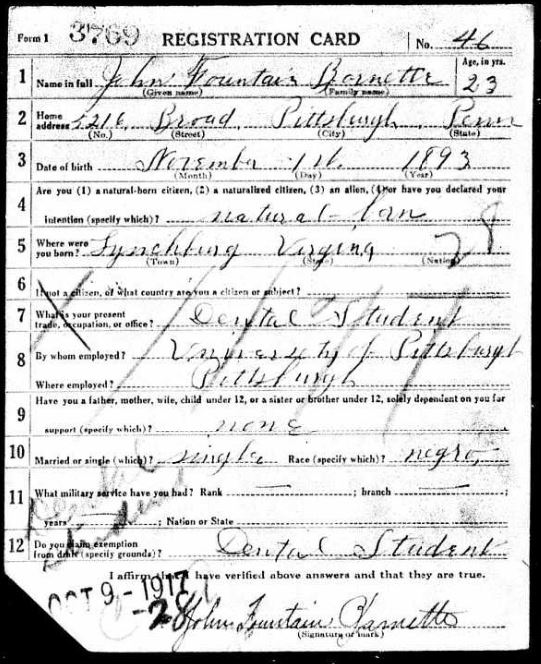
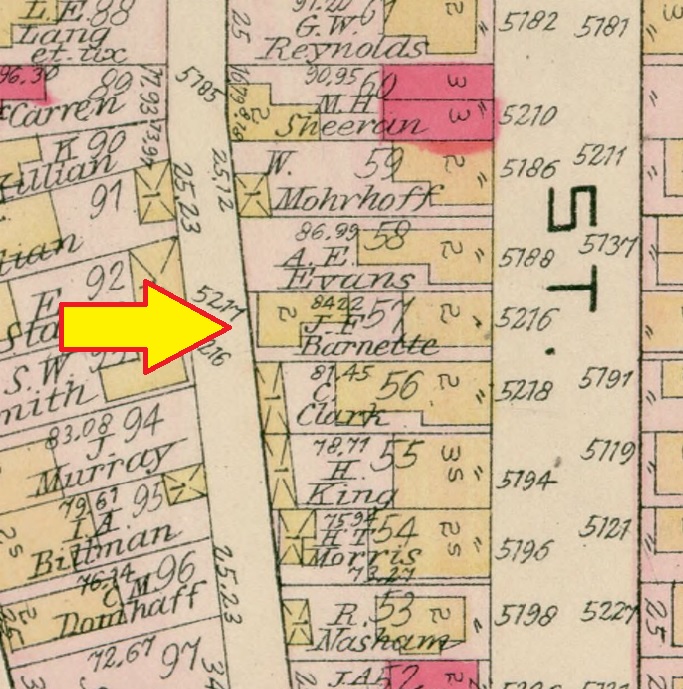
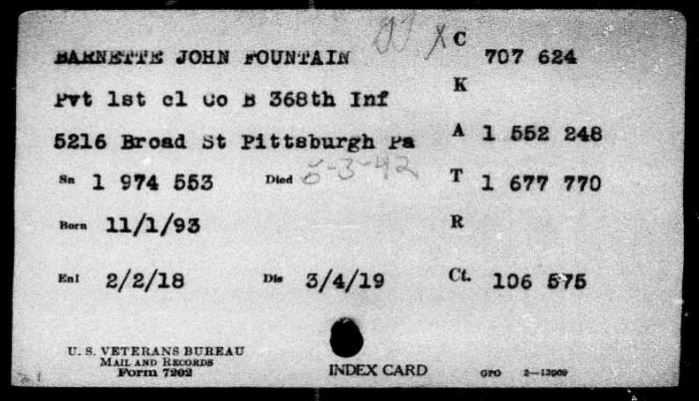
Barnett attended the University of Pittsburgh to study medicine following high school and was also a member of the Pitt Track and Field team. His draft card, signed in June 1917, indicated that he was a dental student living at 5216 Broad Street in the Garfield neighborhood of Pittsburgh. He was then living with his parents, John F Barnette Sr and Mary Merchant Barnett.
Lower left corner – “If person is of African descent, tear off this corner.”
J.F. Barnette Sr parcel at 5216 Broad Street – 1911 – historicpittsburgh.org
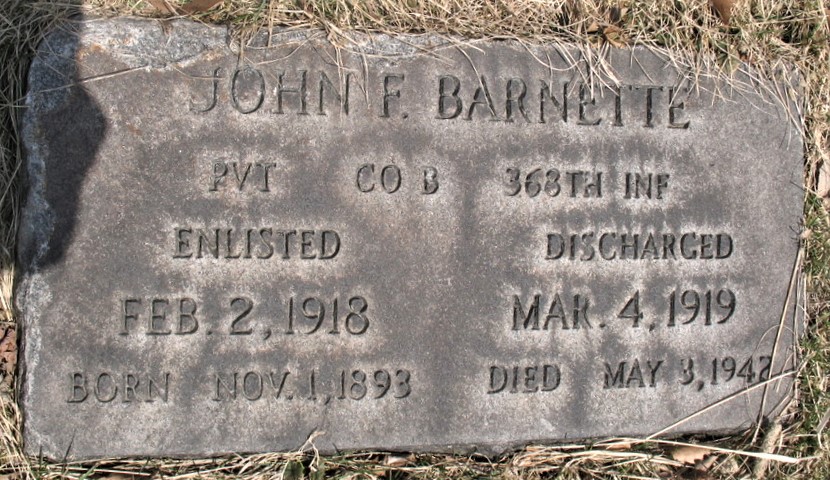
Barnette was inducted into the Army on February 2, 1918, and assigned to the 325th Field Signal Battalion, 92nd Division, organized at Camp Sherman in Chillicothe, Ohio. The 92nd Division, nicknamed the “Buffalo Soldiers,” was one of two segregated Army divisions formed during the war, the other being the 93rd Infantry Division, nicknamed the “Blue Helmet” Division.
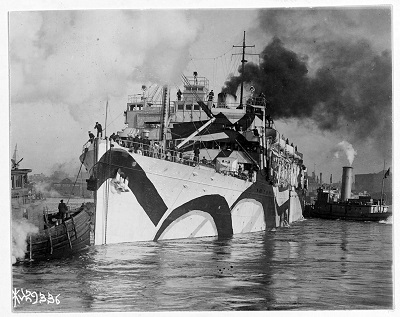
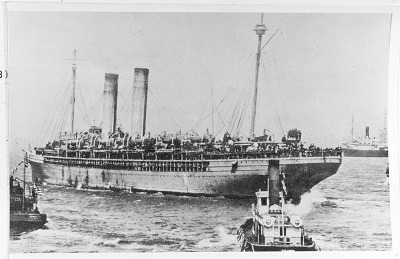
With Barnette attached to a field signal corps unit, he would have been trained on communications between front-line units and division headquarter units using telephone, radio, and aerial mapping, but he may have also learned communications using carrier pigeons or semaphore flags. Just a little over two months after Barnette arrived at Camp Sherman, his father John F Barnette Sr passed away in Pittsburgh at the age of 55. The young Barnette would have completed his initial training at Camp Sherman and then traveled to Hoboken, New Jersey, to set sail for France on June 10, 1918, aboard the troop transport Orizaba. Upon arrival in France, his battalion proceeded to the Bourbbonne-les-Baines training area, and on August 12, they moved near Bruyères in the Vosges Mountains to be affiliated with the French 87th Division for participation in the Saint-Dié Sector.
Camp Sherman accepting new recruits.
Troop transport Orizaba
Less than two weeks before the start of the Meuse-Argonne Offensive, Barnette was transferred into the 368th Infantry Regiment, Company B. This transfer into a combat infantry unit put Barnette directly into the frontlines for the start of the Meuse-Argonne Offensive, and right on the edge of the Argonne Forest. This formidable terrain was heavily wooded with well-built trenches and dugouts constructed during the four years the Germans had occupied this region. On the morning of September 26, 1918, the 92nd Division started their advance with little to no artillery preparation to assist in destroying the fortified wire entanglements in front of the advancing American regiments.
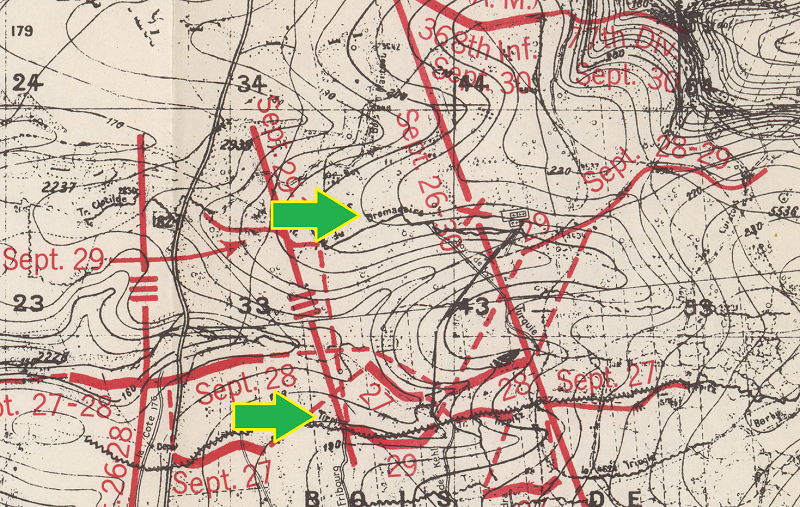
Top arrow points to trench Tripitz and lower arrow pointing to trench Du Dromadaire.
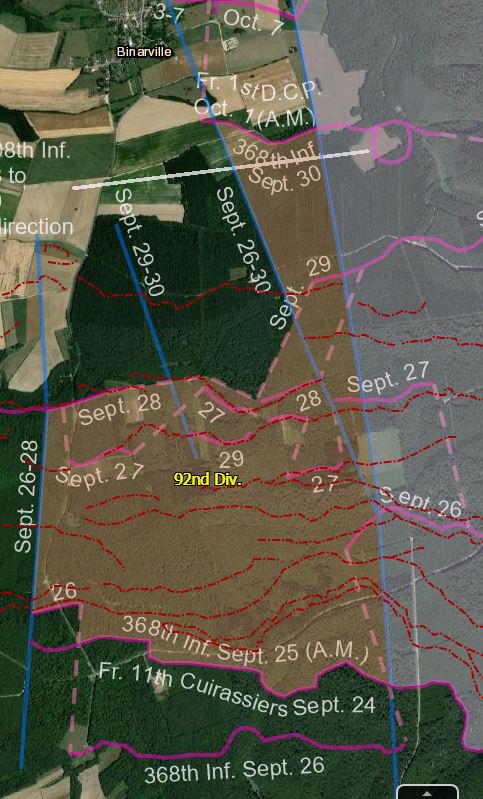
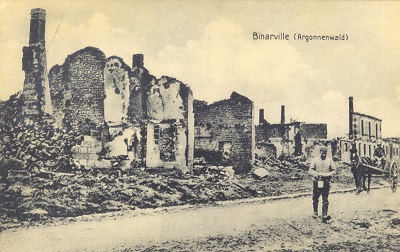
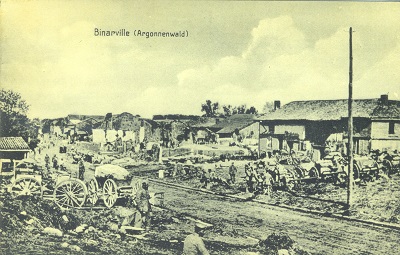
On September 30, 1918, Barnette, attached with Company B, took part in the French assault aimed at taking back the German-occupied village of Binarville. His battalion advanced at 11 AM, moving through the old trenches of Tranchee Tripitz and Tranchee to Du Dromadaire. Working alongside the French troops, Companies B and C received heavy shelling upon entering Binardville, causing them to pull back to positions about 300 meters south of the village. It wasn’t until 4 PM that afternoon that Companies A, B, and C entered Binardville, and were ordered to hold their occupied positions.
The red lines indicate the trenches in the Argonne forest. Binarville is at the top of the image. Source: AEF Resource Map – Weldon Hoppe
The 368th Infantry did not withdraw from the frontlines until the early hours of October 1st and were ordered to move to Tranchee de Damas. Barnette survived his days of combat in the Meuse-Argonne Offensive, but several members of his 368th Infantry did not fare as well; 226 wounded, 42 killed in action, and 16 died of wounds received.
Binardville destroyed by shelling.
Binardville occupied by Germans.
Following the Meuse Argonne Offensive, the 92nd Division participated in the Marbache Sector and Woevre Plain Operation from October 8, 1918, until the end of the war on November 11, 1918. During this period, the 368th Infantry Regiment recorded nine wounded and no deaths. They departed France on February 5, 1919, aboard the troopship Harrisburg, and arrived in New York on February 15, 1919. Barnette was honorably discharged from the Army on April 4, 1919.
Troop transport Harrisburg
Barnette returned home to live with his mother, but it does not appear that he returned to the University of Pittsburgh to pursue his medical degree. The 1920 U.S. Census listed his occupation as a waiter, and in 1930, he was married and working as a clerk in a bond house. In April 1924, just one month before the dedication of the Peabody World War Memorial, where John Barnette’s name has been memorialized, his sister Amanda Beamah Jackson passed away from influenza at the age of 33. Amanda Beamah Barnette was a 1911 graduate of Peabody High, and the mother of three young children, the youngest being Romaine Jackson, who was only eleven months old at the time of her mother’s death. Romaine would grow up and later marry a young man named Earl Childs in October 1941. I mention this couple here because Earl Childs went on to serve in World War II, completed his degree at the University of Pittsburgh in 1953, and practiced general dentistry in the Homewood-Brushton area of Pittsburgh for more than 40 years. This couple’s son, Dr. Earl Douglas Childs, the grandson of Amanda Beamah Jackson, also became a dentist and talked with the Pittsburgh Post-Gazette about his own father’s military service. Before Dr. Earl Childs death in 2004, he told his son of the racism and discrimination against African Americans in the military, and in society, during the Second War, and upon returning to Pittsburgh after the war, his employers refused to pay him while he attended college even though they offered that program to white GIs.2 We don’t know why John Barnette did not continue on with his education at the University of Pittsburgh after returning from the war. Did he stop his education to help support his mother, or did he face similar racial discrimination as experienced by Dr. Childs? The answers here would only be speculative.
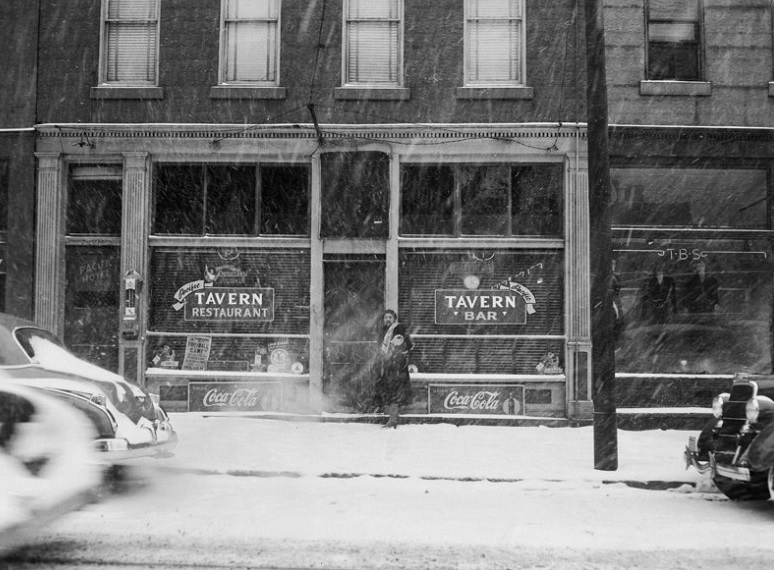
The 1940 census does reveal that John Barnett was living without his wife at the Pacific Tavern on Frankstown Avenue in Pittsburgh. He died on May 3, 1942, at the age of 48 from tuberculosis; his death certificate indicates that he was separated from his wife at the time and working as a floor crane man at the Homestead Steel Company. He was later buried next to his parents, and sister Amanda Beamah, in the Allegheny Cemetery, in the Lawrenceville neighborhood of Pittsburgh.
It was not until 1948 that President Harry Truman issued an executive order to desegregate the military. The lessons we can learn about the treatment of African Americans during the Great War, and the years following, remains relevant today as our nation continues to struggle with racial disparities. Before researching the history of Barnette, I was more familiar with the notoriety of the famous 369th Infantry unit known as the “Harlem Hellfighters,” a regiment of the 92nd Division that is often highlighted when looking for examples of the black soldier experience during World War I. However, I was not familiar with the operations performed by the 368th Infantry and I am grateful to have learned about John Fountain Barnette Jr, a Pittsburgher that we can be proud to honor and remember for his service as an American soldier; he is not forgotten.
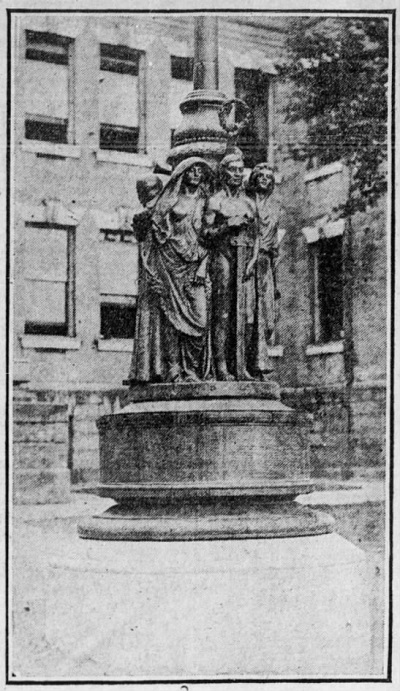
Peabody War Memorial – Pittsburgh Press – May 28, 1924
1 1915, February 1. Pittsburgh Schools an Index to City’s Greatness. Pittsburgh Post-Gazette, p. 12.
2 Srikameswaran, A. (2004, April 29). Obituary: Dr. Earl Childs / Longtime East End dentist; decorated soldier. Pittsburgh Post-Gazette. Retrieved from https://www.post-gazette.com
Colonel George C. Marshall
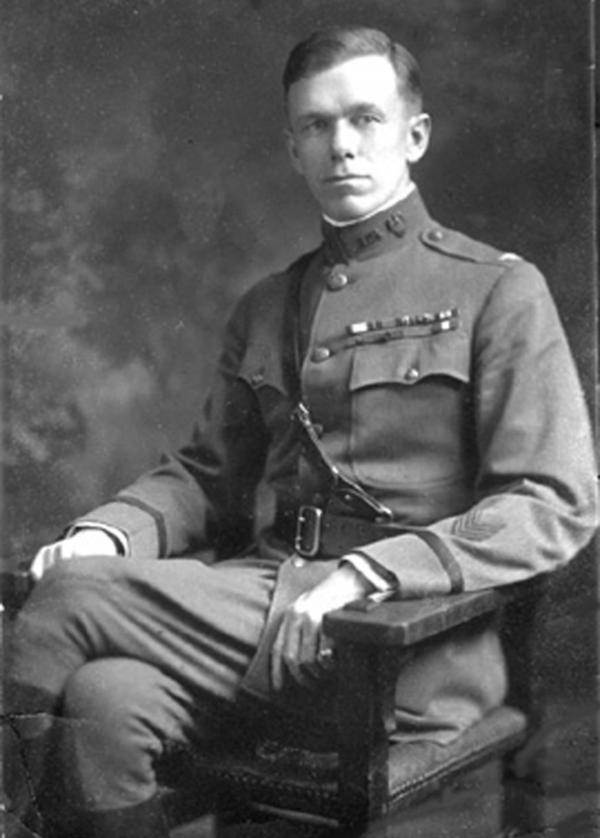
George C. Marshall was born in Uniontown, Pennsylvania on December 31, 1880, and is considered to be a key architect to the Meuse-Argonne Offensive, and while I don’t believe anyone would describe the plan as “dandy,” this was apparently the adjective used by General Drum, assistant chief of staff for the First Army. This quote is taken from the Memoirs of my service in the World War, 1917-1918.
“That order for the Meuse-Argonne concentration you sent over last night is a dandy. The General thought it was a fine piece of work.”
Hugh Aloysius Drum
Marshall’s experiences during World War I shaped his future, particularly the plans he formulated during the Second World War. And while Uniontown is about 45 miles south of Pittsburgh, we are proud to recognize George C. Marshall from Western Pennsylvania as a significant contributor to the Allied victory during the Great War.
Ask any Marine to name a battle from World War I and you will undoubtedly hear “Belleau Woods” recited as an answer. Taught to every new recruit and officer candidate, it was the fighting spirit in the ranks of those men that has become an enduring symbol for the United States Marine Corps. It may also be the lore of this battle that continues to draw historians to study the Battle of Aisne (Belleau Woods) that took place over a century ago.
As a former Marine, I can certainly be accused of perpetuating the lore by reciting the quote by Captain Lloyd Williams, “Retreat, hell! We just got here.” But even growing up on my childhood street of “Belleau Woods Boulevard,” I don’t have the back story on so many of the men who fought in this battle. Author Edward Lengel may have said it best, “the names of the men who broke through the main German positions on June 11, 1918 and turned the tide of the battle are lost to posterity.” While this may be true, I hope to make an effort of honoring these men by learning some of their names.
So, it should be no surprise that this article will highlight at least one Pittsburgher who was leading head-on into this historic fight, but sadly, also became one of the first officers to be killed at the start. Admittedly, I had never heard the name of this particular Marine from Pittsburgh until doing research for my article “Poet of the Future.” In short, I wrote about two friends from Pittsburgh that met one evening in July 1918 during the war. Corporal Francis Hogan offered Lieutenant Hervey Allen the address of a mutual friend whom they both knew from Pittsburgh. This mutual friend, Lieutenant William Dabney Frazier, was attached with the Marines but had already been killed when the two met that evening. Allen could not bring himself to telling Hogan the news of Frazier’s death.
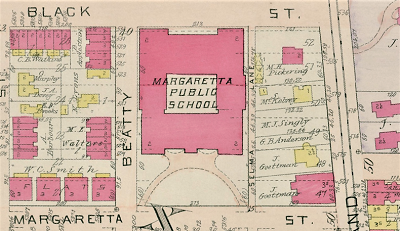
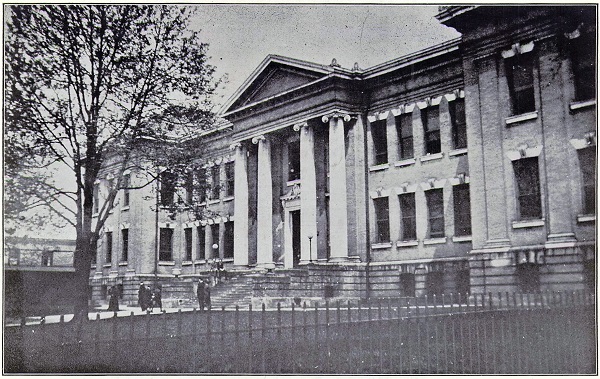
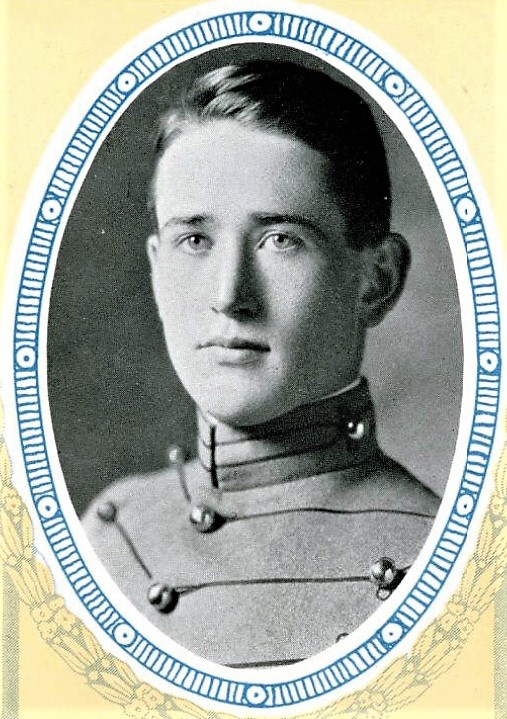
William Dabney “Dabs” Frazier, born in Pittsburgh on December 28, 1896, likely met Francis Hogan at the Margaretta Street school in the East Liberty neighborhood of Pittsburgh. This school building was later expanded and renamed the Peabody High School. Hogan graduated from Peabody in 1916, but his friend “Dabs” spent the last two years of high school at Culver Military Academy, a college preparatory boarding school in Culver, Indiana. Frazier had aspirations for a military career, hoping to attend West Point after high school. He was a member of the Culver football and basketball teams, and a member of their athletics council.
Walter Dabney Frazier – Class of 1916 – Culver Military Academy
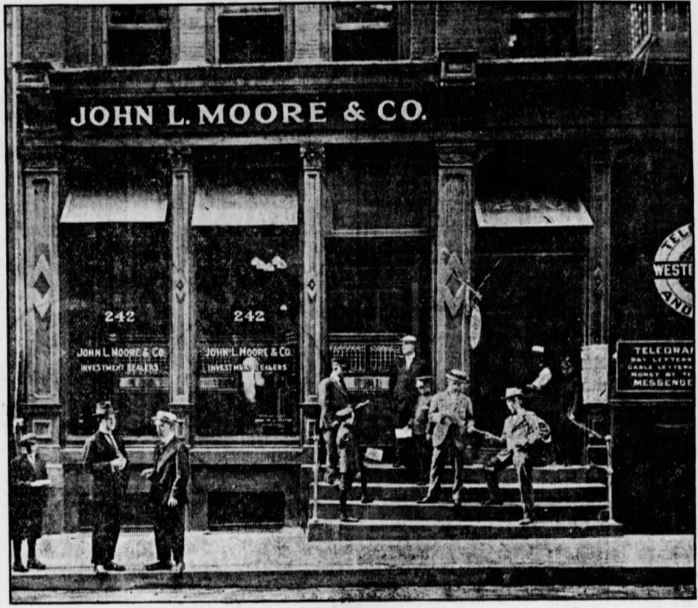
Following his June 1916 graduation, “Dabs” returned home to Pittsburgh where he lived with his father Walter A. Frazier and Mable Dabney Frazer at 5744 Ellsworth Ave in the East Liberty neighborhood of Pittsburgh. When Frazier returned, he would have been walking into a household under great distress as a result of his father’s professional career being turned on its head. Walter A. Frazier was the manager of the John L. Moore & Company Investment Dealers, a brokerage house that managed the investments of the Amber Oil & Refining Company. The same month the young Frazier was graduating from Culver, John L. Moore was being charged with embezzlement, and by November 1916, both John L. Moore and Walter A. Frazier pled guilty before the United States district court to mail fraud, later sentenced to a $1,000 fine and three months in the Allegheny County jail.
242 4th Avenue – John L. Moore Investment Dealers – Pittsburgh Daily Post 1915
It’s unclear exactly how these events played out for the young Frazier, or how he reacted to his father’s legal affairs, but we do know that he left Pittsburgh against his parents’ wishes, traveled to Toronto, Canada, and enlisted in the Canadian Over-Seas Expeditionary Forces. On January 25, 1917, Frazier signed an oath of allegiance to King George the Fifth and agreed to serve for at least one year during the war between Great Britain and Germany. The United States had not yet entered into the Great War, and the 20-year-old Frazier was now in Canada attached to the 208th Battalion of the Canadian Expeditionary Forces.
The following month, Walter A. Frazier contacted the British Consulate in Pittsburgh to get his son discharged from the Canadian unit on the grounds that he was still a minor and an American citizen. While the young Frazier reported 1895 as his year of birth on the enlistment papers, his father provided a copy of a Pittsburgh birth certificate showing the correct year as 1896. The father also provided a statement that read in part that his son “mysteriously disappeared from home and we knew nothing of his whereabouts until informed by through the American Consular Service of Ottawa, Canada, that he had enlisted in the 208th Overseas Battalion of the British Army. He left home against the wishes of his parents, his enlistment in the American or any other armies having been expressly forbidden by myself and his mother.”
On March 24, 1917, the young Frazier was discharged from the Canadian forces after only a few months. Shortly after his return to the United States, Frazier enlisted in the United States Marine Corps on July 6, 1917, exactly three months from the date that the United States officially declared war on Germany. No one can fault the Frazier parents for wanting to keep their only child safe. However, we do know that Frazier had been preparing for the opportunity to serve in the military since he was a young boy, participating in local youth organizations like the Highland Cadets, and the United Boys’ Brigade of America, places where he would first begin to learn the skills of drill and discipline. He was now out of high school, the country was at war, and regardless of what was happening in his family’s personal life, Frazier was ready to serve.
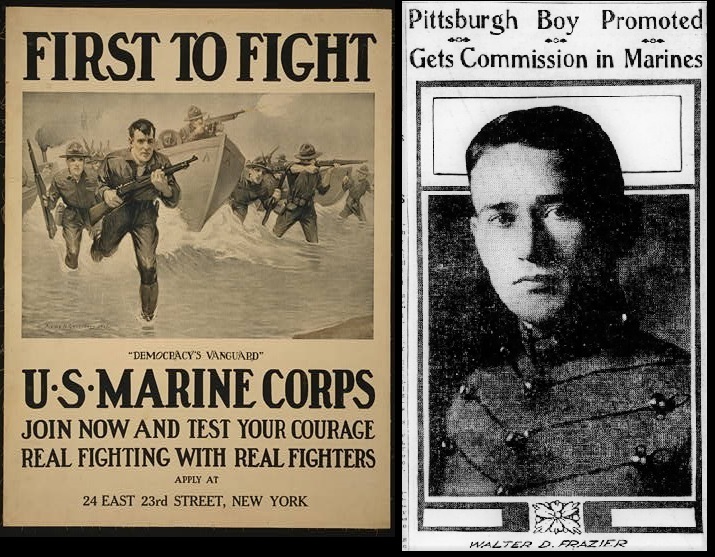
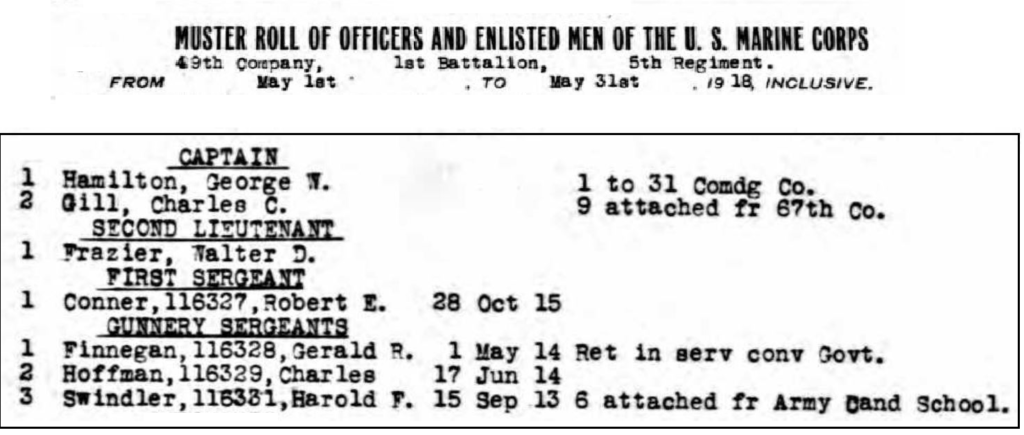
When I see one of the early Marine Corps recruiting posters, First to Fight, I will now think of this young man from Pittsburgh. He was sent to Marine Officers’ Training Camp, Marine Barracks, Quantico, Virginia, and was commissioned a 2nd Lieutenant on August 27, 1917. Following his initial training, he was placed under the command of Captain George W. Hamilton, 49th Company, 1st Battalion, 5th Regiment for service in France.
This is a small clipping of the muster roll that shows some of the names recorded just prior to the June 1918 battle. Take note of a couple of the Marines who served with Frazier. Captain George W. Hamilton led the 49th Company, earning the Distinguished Service Cross and Navy Cross. Gunnery Sergeant Charles F. Hoffman (born Ernest August Janson), was the first Marine to be awarded the Medal of Honor during WW1. WW1 4th Brigade (Marine), 2nd Division, AEF and WW1 AEF Historian and Battlefield Guide Steven Girard records Hoffman’s awards as Medal of Honor (both Army & Navy), Silver Star Medal (1st, & 2nd Award), Purple Heart Medal, French Médaille Militaire, French Croix de Guerre with Palm, Italian Croce al Merito di Guerra (War Merit Cross), Portuguese Medalha da Cruz de Guerra (War Cross), and the Montenegrin Silver Bravery Medal for his actions against the enemy serving with the Marines during the Battle of the Aisne (Belleau Wood).
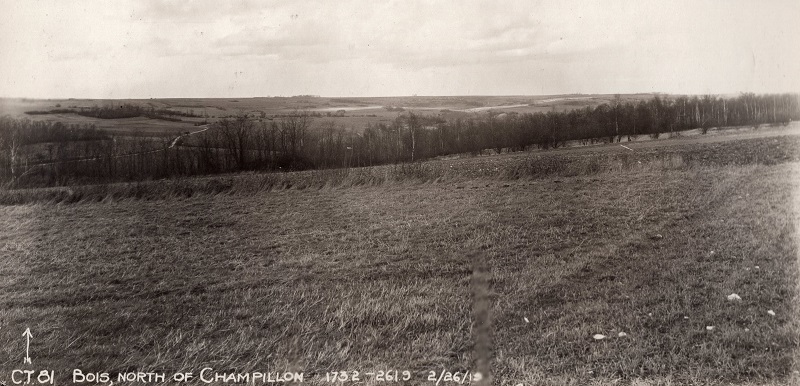
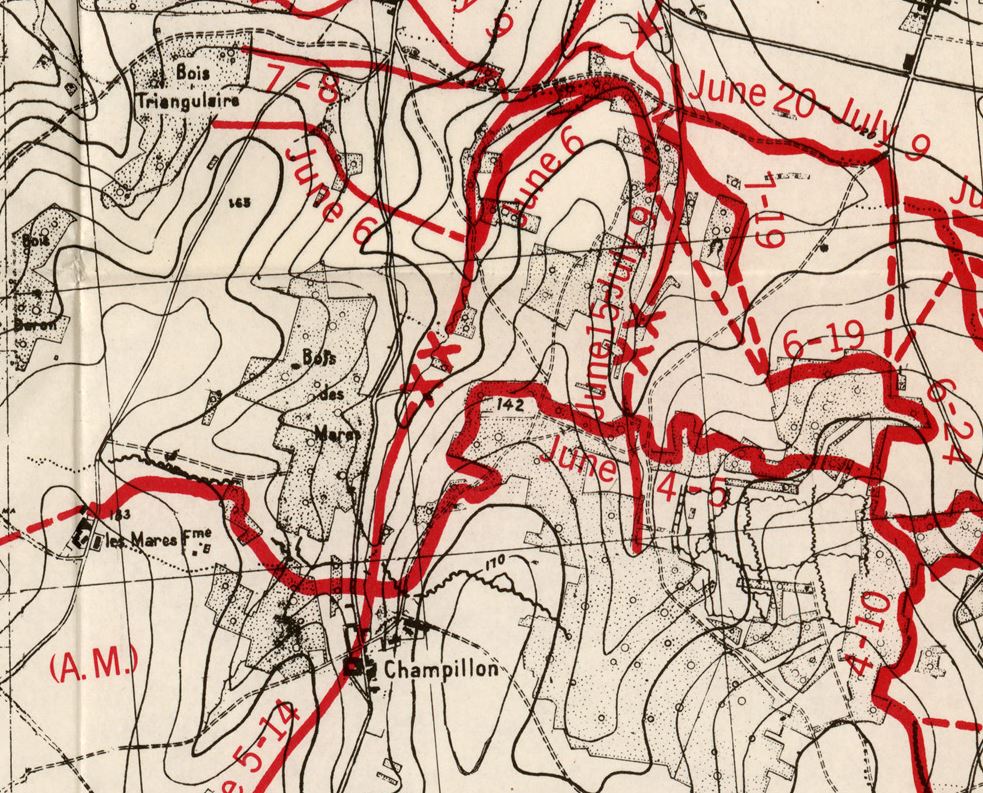
In my eyes, Frazier epitomizes how the Marines are portrayed on that recruiting poster, First to Fight, as he was placed on the cusp of one of the Marine Corps most epic battles, and as a leader of Marines, he was out front, positioning his platoon for an assault on enemy positions near Hill 142, just north of Champillon. It is likely that Fraizer’s actual date of death was June 5, 1918, as he was waiting for orders rumored to have his platoon attack the next day. Some records show his date of death as June 5, while others June 6.
Major Gary Cozzens (USMCR) describes “the capture of Hill 142 as a defining moment in the annals of Marine Corps History.” The terrain (see 1919 Signal Corps photo above) that Frazier was crossing consisted of alternating patches of grain fields and woods, defended by Germans who were placed into positions to confront the approaching troops. This post will not go into the detail of the battle, but I encourage you to read Cozzen’s article “How Will the Americans Behave in a Pitched Battle?” published in the Winter 2018 issue of Marine Corps History where he provides the story of those events, as well as a list of men receiving valor awards for their actions. History shows that 2nd Lieutenant Walter Dabney Frazier was posthumously awarded three of the Nation’s highest military awards for valor, the Distinguished Service Cross, Navy Cross, and the Silver Star, attesting to “the supreme proof of his extraordinary heroism.” Frazier was also awarded the Purple Heart and French Croix de Guerre with Bronze Star.
I am also grateful to Author Kevin C. Seldon, sharing firsthand accounts of his research about Lieutenant Frazier, along with another Marine from Western PA who was with Frazier near Hill 142. Seldon’s book, Among the Ranks of the Carrion Men, gives a glimpse at the graphic details of the horrors of war. Taken from Frazier’s burial file, Seldon provides us with a vivid description of death: “Before anyone could react, the momentary ear-splitting scream of an incoming shell erupted into a blinding flash amidst Frazier’s gathered platoon. A large shell fragment killed Frazier instantly as it struck him in the middle back and passed entirely through his kidney. Deadly shards of steel from the same round tore into several other members of the platoon including 23-year-old Private James Sherman Schall, a carpenter from Armstrong, Pennsylvania. A fragment struck Schall in the face with such force it shattered most of his skull as well as facial bones and blew his lower jaw off killing him instantly.”
I believe we must have these blunt descriptions to remind us of the pure hell faced by these men. It also reminds me to ponder the anguish of the Marine who survived that day, the carnage he witnessed, and the fact that he had to recount the details recorded above. We can only hope that many of the families who lost their sons were spared these vivid details we read today.
Thanks to the work of historian Weldon Hoppe, we now have quick access to search the details on the burial cards for over 78,000 American soldiers in World War I. The information gathered on these burial cards gives us the initial burial location for both Frazier and Schall, but Hoppe’s website also provides quick access to locating others who were buried in that same cemetery. In this case, we know that both men were initially buried in a French civilian cemetery near Bézu-le-Guéry. Again, using a resource developed by Hoppe, we can quickly access the location of this cemetery through his AEF Resources Map.
Shortly after the war, the United States government gave the families of the fallen an option on where their deceased could be buried. The remains of Private Schall, at the request of his father, were returned to the United States and were buried next to the Marine’s mother in Cochran Cemetery, Templeton, PA. The Frazier family also requested the remains of their son be brought back to the United States, and Frazier’s body was interred in Arlington National Cemetery, Arlington, VA on July 28, 1921.
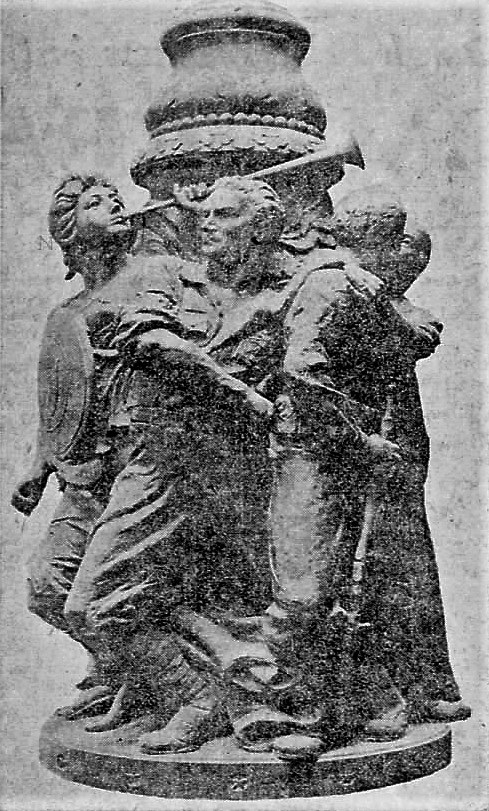
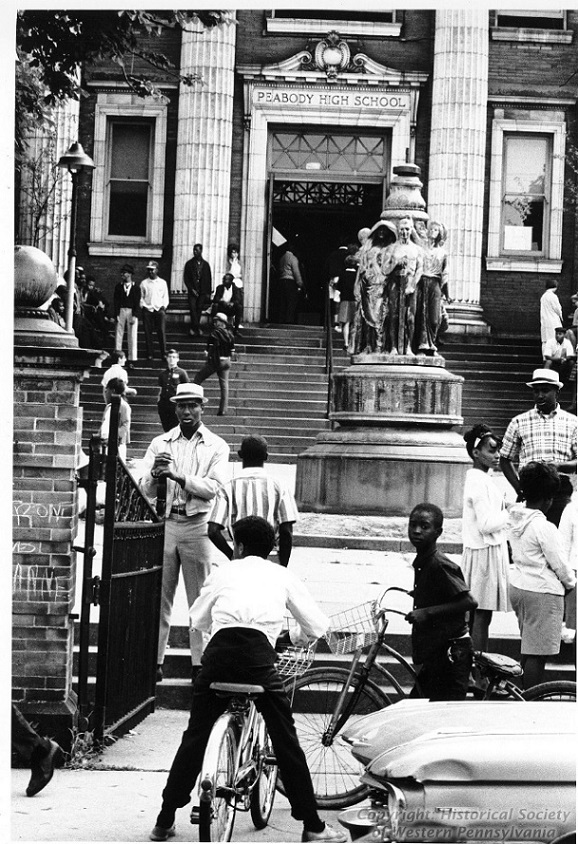
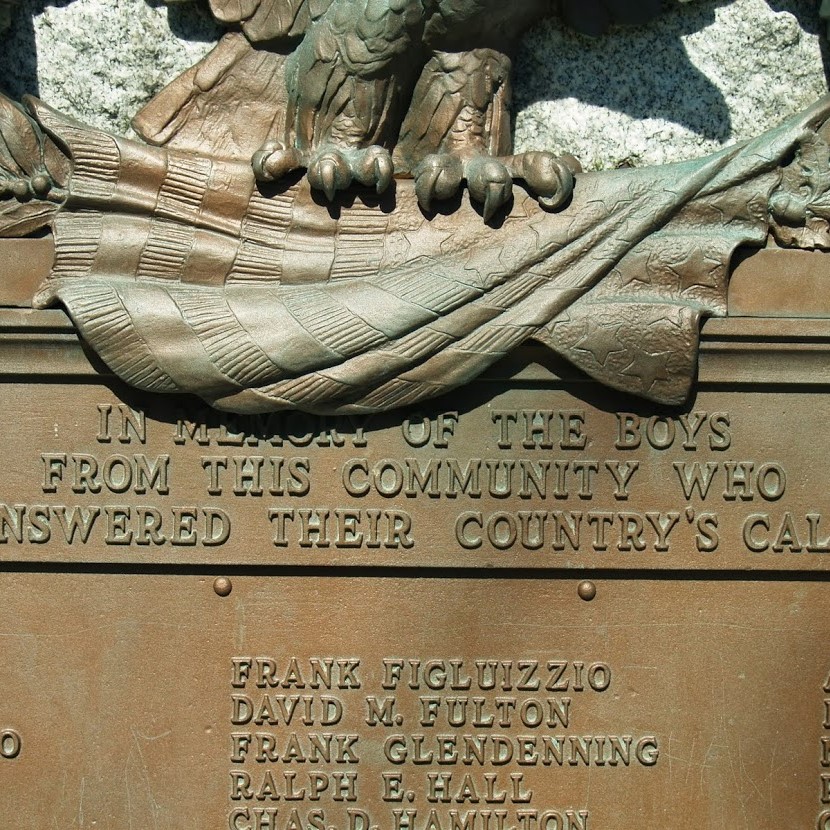
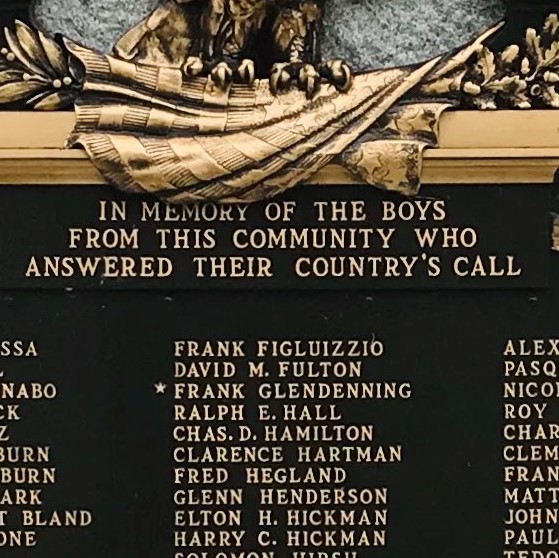
In 1923, the Peabody High School World War Memorial was completed by Frank Vittor, a tribute made possible through the donations of students, faculty, and the general public. The memorial was dedicated during a ceremony on May 30, 1924, and included the names of 17 former Peabody students that died during the war. Frazier’s name, along with his former classmate Francis Hogan, were counted among the dead. Mrs. Mable Frazier, along with five other Gold Star Mothers, unveiled the memorial to the public at the ceremony that day. This war memorial is currently located on the grounds of the Obama Academy in East Liberty and also includes the names of 532 graduates and former students who “offered their all to their country during the World War.” There is presently an effort to refurbish this memorial through Preservation Pittsburgh, and your donation, regardless of the amount, would be greatly appreciated by the organizers.
25 Mar 1923 Pittsburgh Post-Gazette1963 HeinzHistoryCenter.org
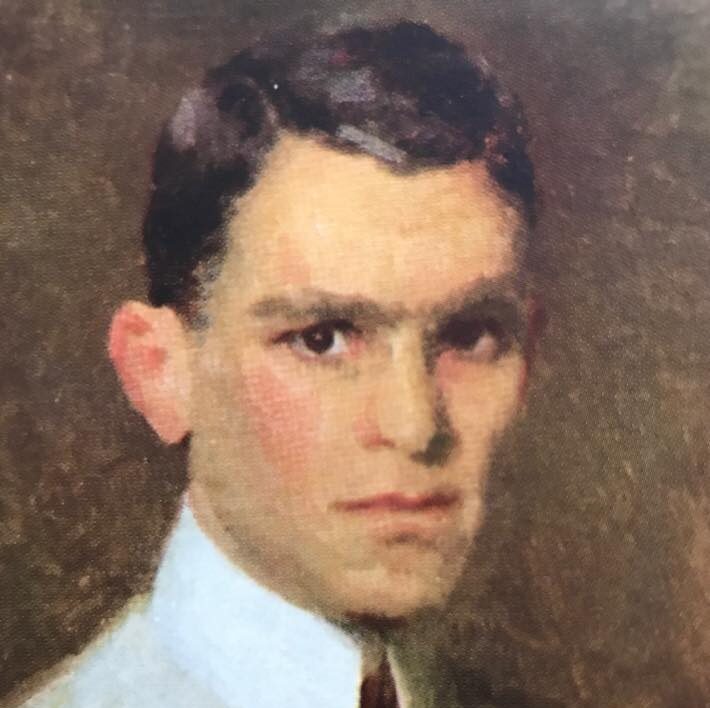
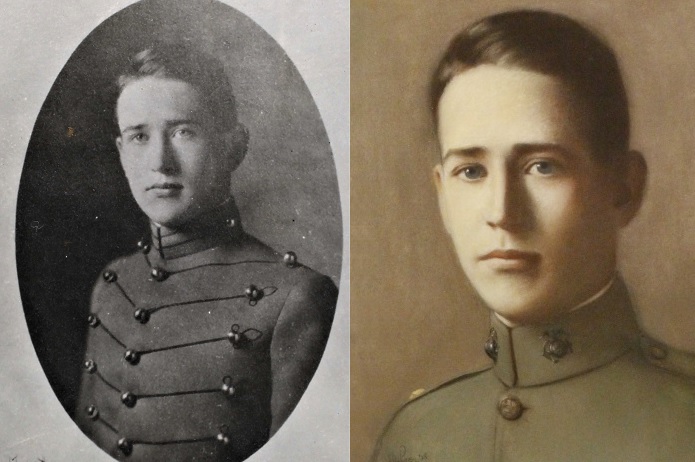
In the Spring of 1925, commissioned by the Culver Military Academy, artist Hue Poe began work on creating pastel portraits of men from the academy who lost their lives during the war. Using photographs from the days the men attended Culver, Poe created portraits of each deceased wearing the uniform of the branch in which they served. The portrait of Frazier is shown here with the Marine Corps eagle, globe, and anchor collar insignia, as well as his 2nd Lieutenant bar on his shoulder.
William Dabney Frazier (1896-1918) Photo: Connecticut, Military Questionnaires, 1919-1920; Pastel portrait https://culverhistory.wordpress.com/
Story by Andrew Capets
Poet of the Future
One of the interesting curiosities of researching the Great War, when focusing on it from a Pittsburgh perspective, has been the seemingly coincidental relationships among the many people being studied. A few years back I was watching a video lecture given by historian and author Edward Lengel discussing his book To Conquer Hell. He recommended a book written in 1926 by William Hervey Allen Jr called Toward the Flame; A Memoir of World War I. As I was reading Allen’s book, one of the key subjects written about in his story was a person whom I was familiar with from my local historical society research, Lieutenant Frank Glendenning, a soldier from my hometown of Trafford, Pennsylvania. I knew a little bit about Glendenning because his name appears on our local WW1 memorial, and our group of volunteers in Trafford had recently honored Glendenning during a memorial park renovation project. Suddenly, Allen’s story had a heightened interest and I had a difficult time putting this book down. Despite already knowing how the story ended for Glendenning, I was drawn into Allen’s writings, learning more details about the war through this local connection.
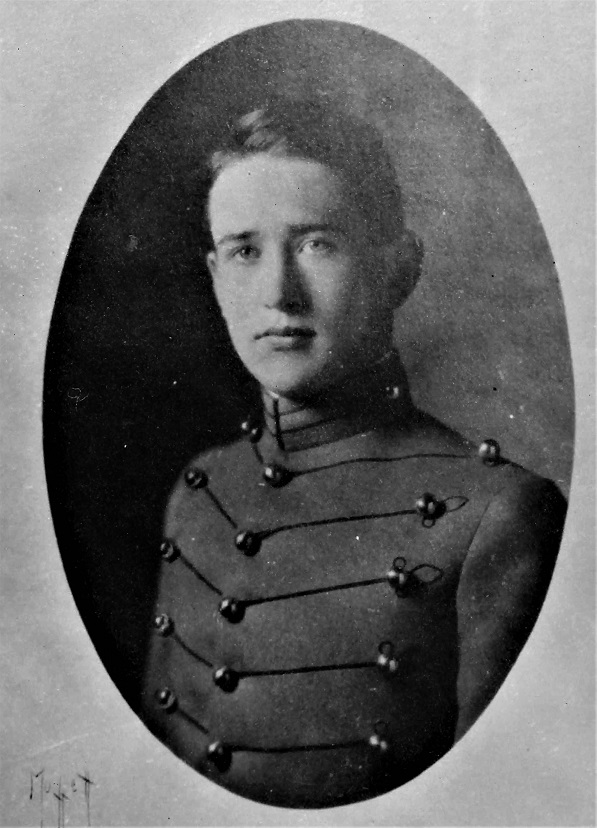
There was one particular incident in Allen’s book that I wish to highlight here because he writes about four men from Pittsburgh within just a few pages of his chapter titled “The March to Château-Thierry.” The chapter discusses an event that took place in July 1918, just outside of Château-Thierry, where Allen, serving with the 111th Infantry, (28th Division) learns that he is located near the 4th Infantry (3rd Division), and the unit in which his good friend Francis Fowler Hogan from Pittsburgh was a member. Allen was hoping to be able to locate this regiment, and in particular, meet up with his friend. Hogan and Allen likely knew each other from the times they sang together in their church choir, Allen being seven years older. Hogan was still a junior in high school when Allen received his bachelor’s degree from the University of Pittsburgh in 1915.
ALLEN
HOGAN
GLENDENNING
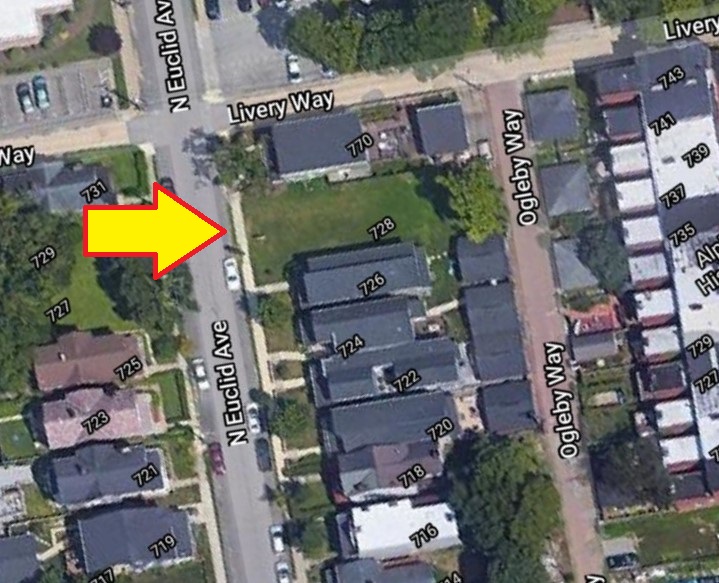
Francis Fowler Hogan was born in Pittsburgh on November 13, 1896, to Thomas and Emma Hogan who once lived in the East Liberty neighborhood of Pittsburgh. The family home at 730 N Euclid no longer exists; only an empty lot remains today. Thomas Hogan was a tea and coffee dealer in Pittsburgh and died in Saint Francis Hospital of pneumonia just one day before Francis Hogan turned eleven.
Hogan attended Peabody High School where he took part in the debate team, drama club, and the literary society. In May 1916, he took part in the Oscar Wilde class play titled, “Importance Of Being Earnest,” and a classmate commented on his performance stating, “Mr. Hogan as Algernon Moncrieff was his own charming self to the delight of his audience.” Hogan was also editor of the student newspaper, The Melting Pot, and graduated high school in 1916 with honors. Following graduation, he entered the newly formed School of Drama at the Carnegie Institute of Technology (present-day Carnegie Mellon University).
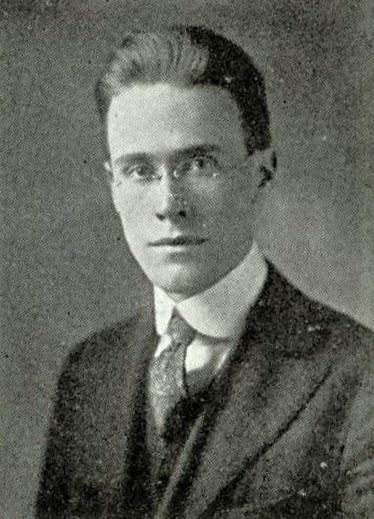
Francis F Hogan – Class of 1916 Peabody High School
On April 6, 1917, the United States declared war on Germany, and within two months, Hogan enlisted in the National Army. He was first sent to Camp Colt in Gettysburg PA, then to Camp Greene, NC, and finally to Camp Stuart, VA, a troop clearinghouse during the war. He boarded the troop transport “Great Northern” exactly one year to the date that the United States declared war. Hogan was assigned to Company M, 4th Infantry Regiment, 3rd Division, and would take part in three major military operations, Aisne-Marne, Saint-Mihiel, and the Meuse-Argonne.
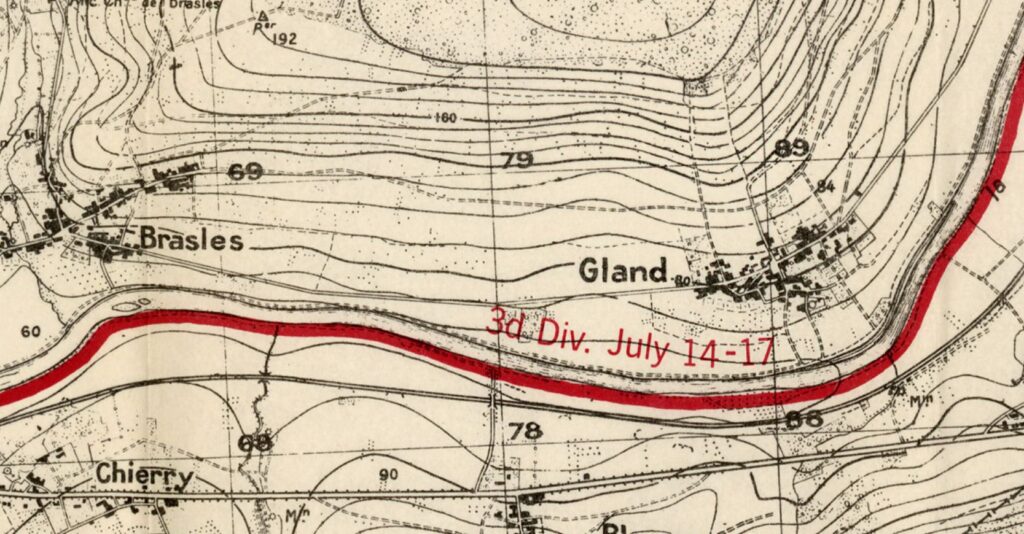
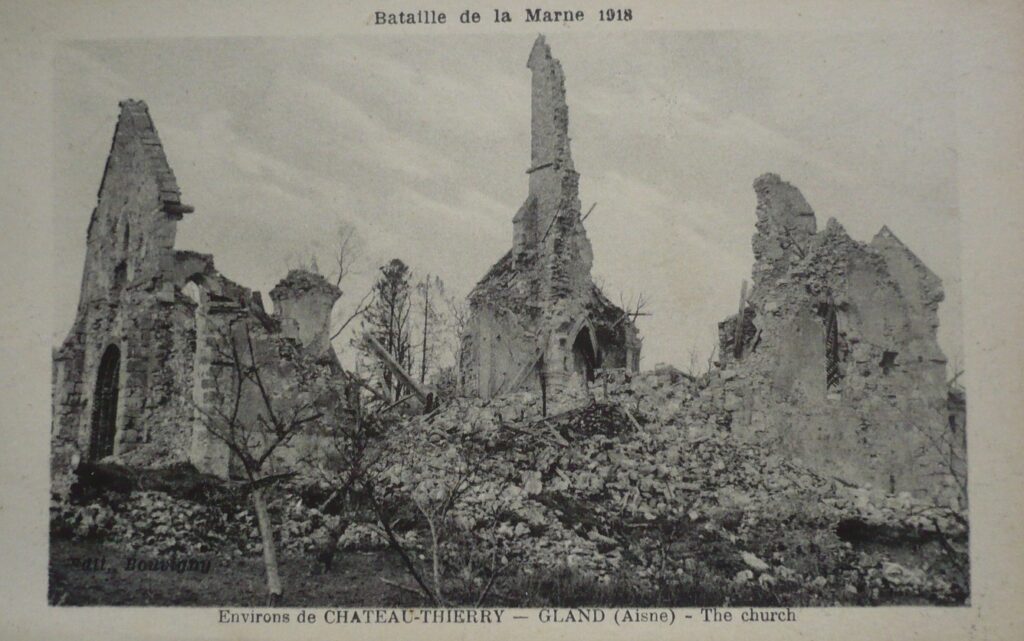
One evening during the Aisne-Marne Offensive, Allen was given an order from General William Weigel to deliver a message to the commanding officer of the 4th Infantry, Colonel Halstead Dorey, to provide the colonel with troop locations and front-line positions of the other units in the vicinity. Allen took one officer with him to complete this liaison, choosing Lieutenant Frank Glendenning. Allen provides a fascinating account of trekking across this worn-torn part of France with Glendenning in order to deliver the message to the colonel who then held his command post in the ruins of a 15th-century church in Gland. This church was destroyed by the Germans in 1918. A new church was rebuilt across the street from these ruins in 1919. Upon delivering the message, Allen asked the colonel where he might find Company M; the unit was situated directly across the street from the church.
Postcard of the church ruins in Gland, France, shared by Historian and Honorary Marine, Gilles Lagin
Allen was able to locate Hogan and they could visit with each other for only about ten minutes. There is a heartening exchange between these two friends when Hogan wants to share the address of a mutual friend from Pittsburgh, William Dabney Frazier, whom they “had known in happy times.” Allen was given the address by Hogan, but Allen makes a decision to withhold the fact that he already knows that Frazier was dead. Lieutenant Frazier was killed in action while he was serving with the 5th Marine Regiment during the Chateau-Thierry Offensive. It must have been trying for Allen to spare his friend Hogan from the immediate grief of Frazier’s demise, Allen writing, “We seemed too close to it all then.”
We know that Hogan did learn about his friend Frazier’s death during the war as he wrote home to his mother on July 31, 1918, telling her about the brief meeting with Allen. “One night on the Marne, while the great second battle was on, I met a friend. We had only a few minutes together, but I managed to give him the address of a friend of both of us whom I had just heard from. He was a fine chap, the absent friend, and I had known him when we flew our kites in Highland Park. I was badly hit when I learned he had been killed.” Hogan also learned that Allen withheld the information about Frazier’s death when they were together that night in Gland, Hogan writing, “The other day I received a letter from the fellow I had met on the Marne [Hervey Allen]. He was in hospital. He wrote: ‘Dab’s snuffing out is bad. I knew it the night I talked to you, but couldn’t say anything to you when you gave me his address.’
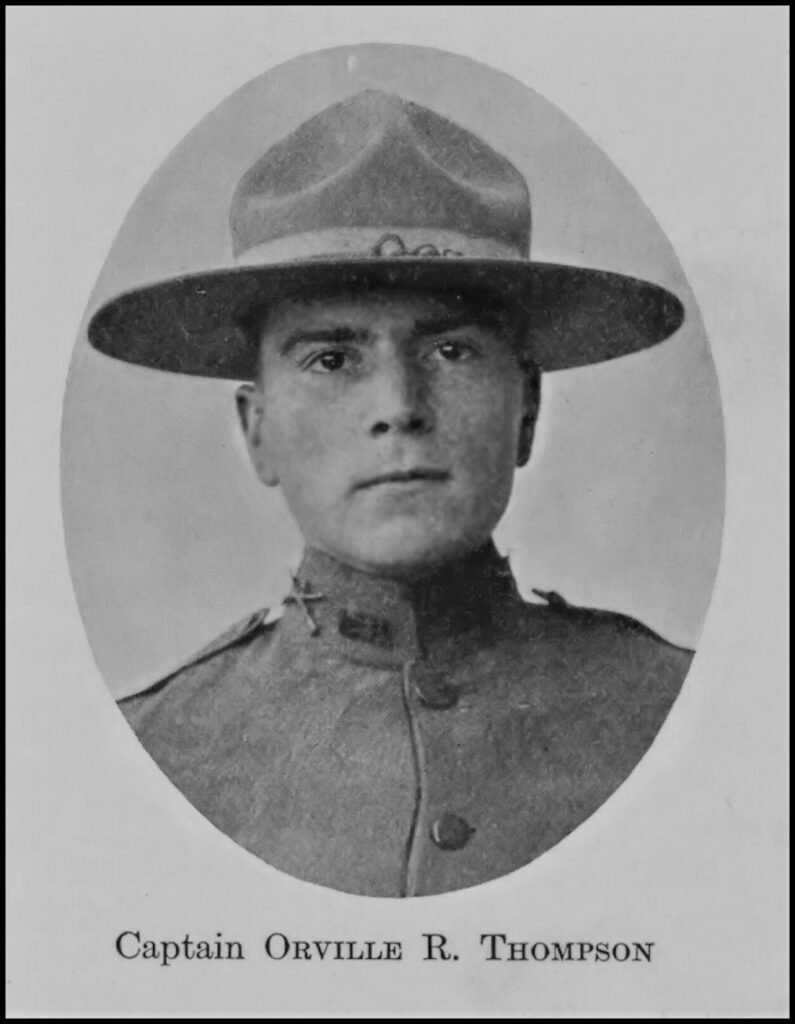
Allen and Glendenning left Hogan just as another round of German shelling began, and so they started back to their own regimental command post. Dodging the shells along the way, they made it back to report the situation to General Weigel. Upon entering the village of Brasles, Allen met up with another Pittsburgher, Captain Orville Thompson, who was “watching the result of the shelling rather anxiously.”
The following month, both Capt. Thompson and Lt. Glendenning would lose their lives in the Battle for Fismette. Allen was wounded during this campaign and had to be evacuated to a field hospital to recover. These injuries kept him out of the next major battle, the Meuse-Argonne Offensive.
FRAZIER
THOMPSON
During the Meuse-Argonne Offensive, the 3rd Division received field orders that directed Hogan and his 4th Infantry to be place in the new offensive, battling to clear the Germans from the Cunel Heights. During the evening of October 16-17, 1918, orders directed the 3rd Division to mop up Bois de Forêt and Clairs Chênes woods, and consolidate all ground gained to the north. It was during this period of fighting that Corporal Francis Hogan was killed.
The total strength of the 4th Infantry during the Meuse-Argonne Offensive on September 30th was 3,662 men. Following the hostilities in October, this strength was nearly cut in half in just one month, leaving only 1,843 men remaining. The casualty numbers for the 4th Infantry for the dates of October 14-27 record 414 men wounded, 37 died of wounds, and 143 killed in action, of which Francis Hogan would be counted.
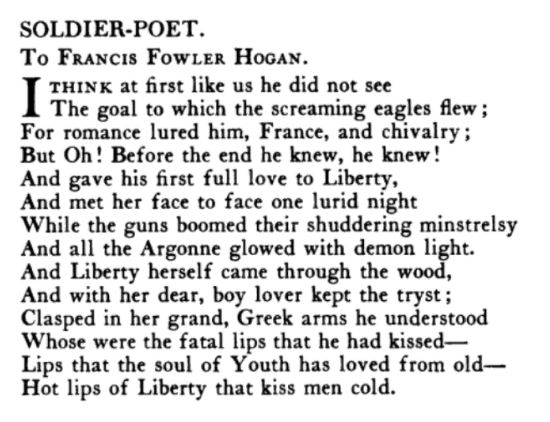
I’ve thought about that one night in Gland as recalled by Allen, and wonder how he processed losing so many friends in a few months time, and in particular, his friend Hogan. I don’t doubt that writing about his experiences at war was a method of coping with his grief. He took quite a risk to seek out his friend, even for just a few minutes of conversation. In 1921, Allen published a book of poetry and dedicated the book to his friend, including the poem “Fulfilled” written by Hogan while aboard his troop transport heading to France. Hogan’s poem was so well received at the time that his work was included in the publication The Poets of the Future – A College Anthology for 1917-1918.
Dedication page by William Hervey Allen written in 1921; Wampum and Old Gold
Poem by William Hervey Allen (1921); Wampum and Old Gold
After Hogan was killed, his remains were initially buried in a temporary gravesite in Cunel. On April 19, 1919, his remains were disinterred and reburied in the Meuse-Argonne American cemetery in Romagne-sous-Montfaucon. At the request of his mother, Corporal Hogan’s remains were disinterred and shipped back to the United States where they were received by the H. Samson Funeral Home on Sixth Avenue, Pittsburgh on August 11, 1921. Services were held at the Samson chapel on Saturday, August 13, with Hogan’s final resting place in the Homewood Cemetery, Pittsburgh.
The following is believed to have been last poem ever written by Hogan titled “The Adventure.” It was included in a letter received by his mother and shared with the Pittsburgh Dispatch in November 1918.
I have found a cave. Dark and very deep; Who may know what wanders In the cannon sleep?
Maybe there are gems And a heap of gold; Maybe sacred volumes Stored there of old.
Maybe there are poppies Which the gnomes hoard; Bit of dragon skin, Or a broken sword.
Or a queen enchanted Whom we may free; Maybe only death – Come, let us see.
Francis Fowler Hogan
Portrait Artist at War
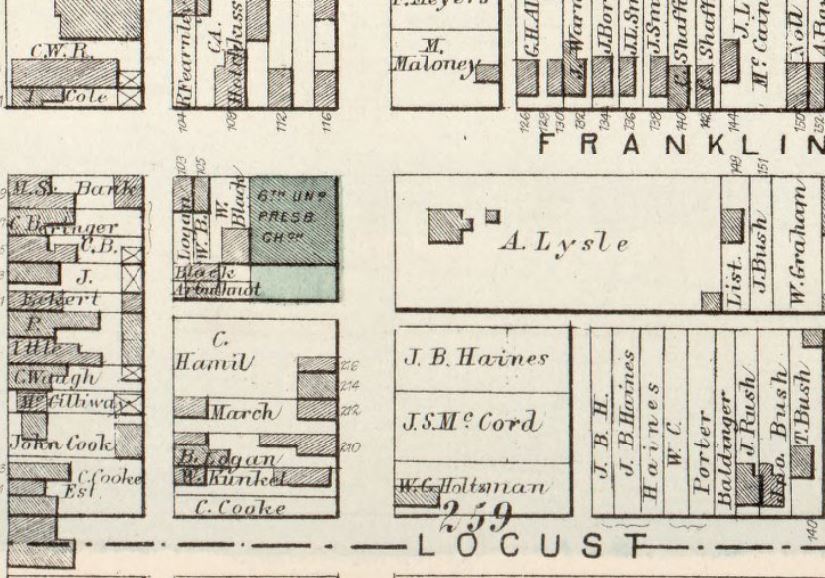
At the corner of Chateau and North Franklin Streets, in the Manchester neighborhood of Pittsburgh, there once stood a three-story home built in 1865 by Allison Lsyle, a coal barge captain who operated a successful business of delivering coal up and down the Pittsburgh Rivers. The once-grand home, with marble fireplaces and walnut woodwork, would later become the residence of the Edward William Demmler family in the heart of Manchester. The home was flanked by two churches, making this corner of Pittsburgh a lively district in “Old Allegheny” for many years. This property is of interest because it was once the home of celebrated Pittsburgh artist Frederick A. Demmler, one of the many young Pittsburghers, full of enormous promise and potential, who had his life cut too short on the battlefields of Europe during the Great War.
1872 map (left) showing the location of Addison Lsyle’s property, and (right) a 1907 map showing the Demmler property. @HistoricPittsburgh.org
“Their names, ultimately, will pass into oblivion, as all names except a favored few, must pass, but no years can efface their deeds, and they, though forgotten, will live forever in the immortality of their service.”
Unidentified author, from “They Who Return Not.” Saint Louis Globe-Democrat, November 16, 1918
The suggestion to research Frederick A. Demmler came to me via a social media message. Demmler was a soldier from the Great War that I was unfamiliar with, but the more I uncovered his story, the more I questioned why, as the quote above eluded, was he one of the favored few? With just a few online searches, I quickly discovered that Demmler would not be one to fall into oblivion, and we can acknowledge the many who knew him for creating works that honor and remember their friend, Fred A. Demmler.
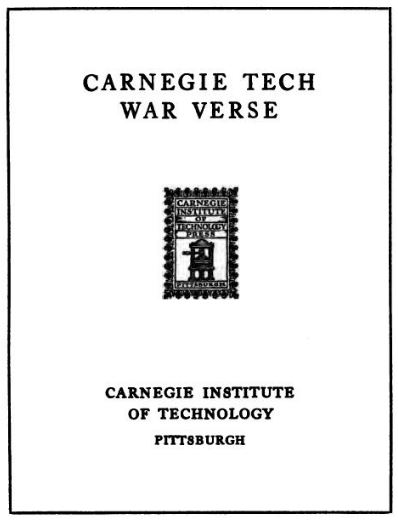
In my initial search, I came across a portrait painted by Demmler that I recalled seeing two years ago in an article written by historian Jennie Benford for the Western Pennsylvania History Magazine, Vol. 100, No. 4. It was about World War I soldier and poet Frank Hogan. The article discussed a two-book set printed in 1918 titled The Soldier’s Progress and Carnegie Tech War Verse. The books were edited by English professor Haniel Long of the Carnegie Institute of Technology (present-day Carnegie Mellon University), who once sat to have his portrait painted by Fred Demmler. The impression that Demmler left on Haniel Long was obviously an impactful one, enough to carry the memory of the young artist into a literary piece written in 1935 by Long called Pittsburgh Memoranda. Long wrote a chapter about Demmler in his book, along with other Pittsburgh notables such as Andrew Carnegie, John Brashear, George Westinghouse, and Stephen Foster.
Fred A. Demmler with his portrait of Haniel Long
I also discovered that composer Harvey B. Gaul wrote a piece of music in 1919 for the organ titled, “Chant for Dead Heros,” published as a dedication to Sergeant Fred Demmler and Corporal Francis Hogan. These works illustrate an effort to memorialize and ensure that Fred Demmler would be remembered by future generations. But the central piece of literature I found to best understand Fred Demmler was written in 1919 by Lucien Price, titled Immortal Youth: A Study in the Will to Create, published by McGrath-Sherrill Press. This literary work gives us a personal look into stories about Demmler, written by his dear friend, which ultimately challenges us as readers to keep the memory of his friend living, not by his art alone, “but by the living deeds of you.” Price writes, “Why should I point him out to you among the millions?” I again come back to the quote illustrated above, “except a favored few,” because I believe we are fortunate to have the work of Lucien Price, a successful writer, and journalist, made available to us through Project Gutenberg, and I encourage you to read the dedication to Demmler in its entirety.
As an artist, Demmler left behind a body of work that we can certainly appreciate today. I discovered a Facebook community page dedicated to the memory of Fred A. Demmler that includes several photographs of his work that have been made available through this social media page. But what I believe I have learned most significant about Demmler, absent his artistic talent, was how much he was admired by his friends and the influence that he ultimately left on others. This fact became evident as I explored the writings and histories left behind as tributes to his memory.
Frederick “Fred” Adolph Demmler was raised in the Old Allegheny neighborhood of Pittsburgh (present-day Manchester) by his mother Wilhelmina “Minnie” Demmler, and his father Edward William Demmler, who served as president of the Demmler & Schenck Company. By all accounts, the Demmler family lived a comfortable life as a result of the father’s successful business providing kitchen appliances and equipment to the Pittsburgh region.
An advertisement that appeared in the University of Pittsburgh yearbook, The Owl.
Fred Demmler grew up in a household with six brothers and one sister, and was afforded the opportunity to study his craft and hone the skills needed to prepare himself for making art his livelihood. Given the opportunity to live anywhere, Demmler chose to stay in Pittsburgh. He told his friend Price, “I want to paint, and I do not want to have to play social politics in order to get commissions, as I am afraid I would have to do in Boston. Besides, in Pittsburgh, there are fewer painters to influence me. I stand more chance of being myself.”
He once served as vice president of the Associated Artists of Pittsburgh, first organized in 1910. His painting “The Black Hat” was selected for exhibition in The Carnegie International. In 1916, his portrait titled “Vera” won third prize in a competition and was selected by One Hundred Friends of Pittsburgh Art to be placed in a Pittsburgh public school for observation and study by the students.
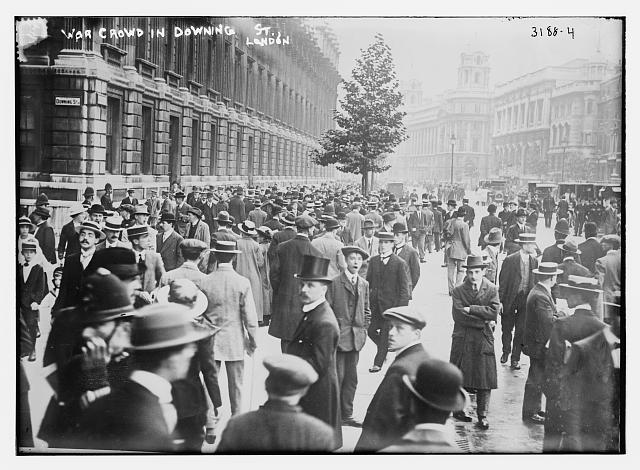
Shortly after Demmler completed his initial studies in the United States, he took a trip to Europe to explore and study many of the great works of art found in their museums and galleries. When Germany invaded Belgium in 1914, and Great Britain issued an ultimatum demanding that Germany withdraw its troops, Demmler was part of the crowd that gathered outside of Downing Street waiting to hear what would happen next. When the deadline given to Germany passed without a reply, Britain declared war. Demmler told his friend Price, “It gave one an odd feeling to realize that behind those drawn shades sat men who were settling the question of life or death for hundreds of thousands of their fellow creatures. The crowd cheered. I did not.” Four years later, Demmler would be buried in Belgian soil, just nine days before the end of the Great War.
Downing Street, London 1914
Demmler returned from Europe to work at his craft. He painted in a studio on the grounds of the family homestead, the house at the corner of Chateau (formerly Chartiers Street) and North Franklin Streets. The house is now gone, but what does still remain on the property is a two-story brick building that once served as Demmler’s painting studio. It was considered the playhouse for the children. Demmler also rented a studio in the Garrison Building at the corner of Third Avenue and Wood Street. This building has been razed and is now a courtyard on Point Park University property.
This two story building once served as the Demmler children’s playhouse and studio for Fred A. Demmler; Chateau Street, Pittsburgh, PA.
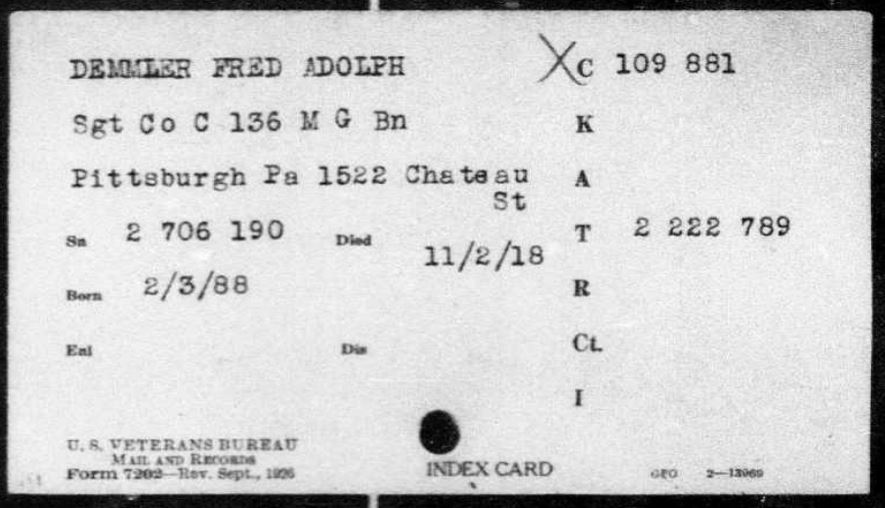
To appreciate Demmler’s character, I found it admirable how he approached his war service. When completing the draft registration card in June 1917, each registrant was asked, “Do you claim exemption from the draft?” Fred Demmler wrote, “Conscientious Objections.” Price wrote about his friend’s struggle with war and conscription, but once Demmler was placed into the ranks, this objection did not appear to impede his disposition, and he was soon identified as a leader among the men while serving at Camp Lee. He was eventually advanced to the rank of Sergeant and a platoon leader in Company C, 136th Machine Gun Battalion, 37th Division.
June 1917 Draft Registration Card
But Fred Demmler wasn’t alone with his struggle on the concept of going to war. Of the seven brothers, four were required to register for the initial draft, and at least two brothers claimed exemption based on conscience. Brothers Paul, Walter, and Alfred fell outside of the first draft age requirements (men 18-30 years) so we don’t know how they would have answered this question.
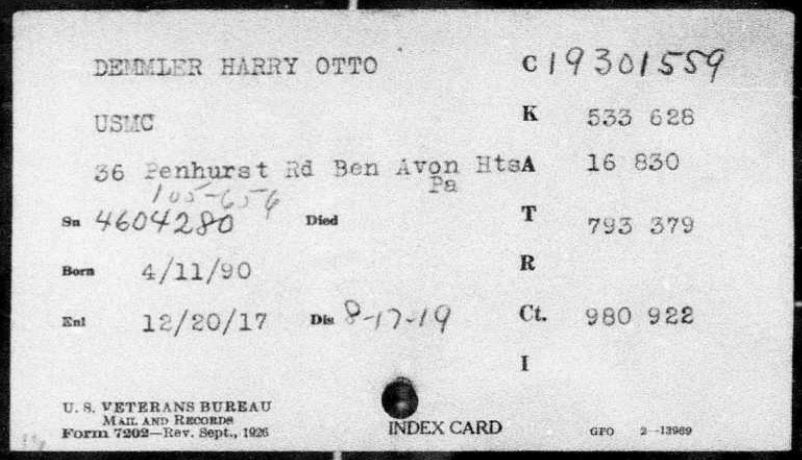
Harry O. Demmler, age 27, a clerk for the Manchester Realty Company in 1917, did not answer the exemption question at all on his draft card. He enlisted in the Marine Corps in December 1917, trained at Parris Island, SC, and would later participate in one of the Marine Corps most brutal campaigns to take place near the end of the war, the crossing the Meuse River. Harry Demmler served as a Sergeant in the 5th Marines, 43rd Company, survived the crossing, and was part of the occupation of Germany. He was later promoted to Gunnery Sergeant before returning to the United States.
Oscar W. Demmler, age 25, was a public school teacher at the time of the draft. Like his brother Fred, he too claimed exemption based on “Consciention,” but was still required to serve, and did so for 10 months overseas during the war. He was spared any direct involvement in hostile engagements.
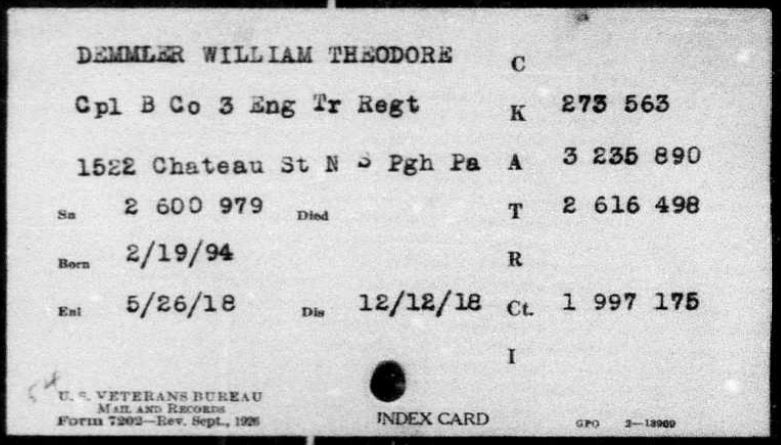
And finally, William T. Demmler, age 23, was working as a clerk in his father’s business. He also answered the exemption on the draft cards as “Conscientiously opposed.” He was not required to go overseas during the war, but he did serve in an Engineering Training Regiment in Virginia for about seven months.
Fred Demmler, along with his 136th Machine Gun Battalion, left Newport News, VA on June 22, 1918, aboard the troop transport Caserta headed for France. During the first phase of the Meuse Argonne battle, Demmler was hit in the shoulder and arm with shrapnel. Price wrote that his brother later learned that “He [Fred] picked out the pieces of shrapnel himself and had the doctor bandage him. After which he went about his work as usual.” The evidence of admiration is clear in Price’s writings, illustrating how well respected he was among the men of his unit. An example of his positive attitude was expressed by one of his fellow soldiers, “He never said a harsh word. He was always cheerful and never kicked. When we complained about the feed or anything, he said it would be better later.” When asked if Fred had a particular ‘buddy’ in the unit, one of the sergeants responded, “No. He was everybody’s friend.”
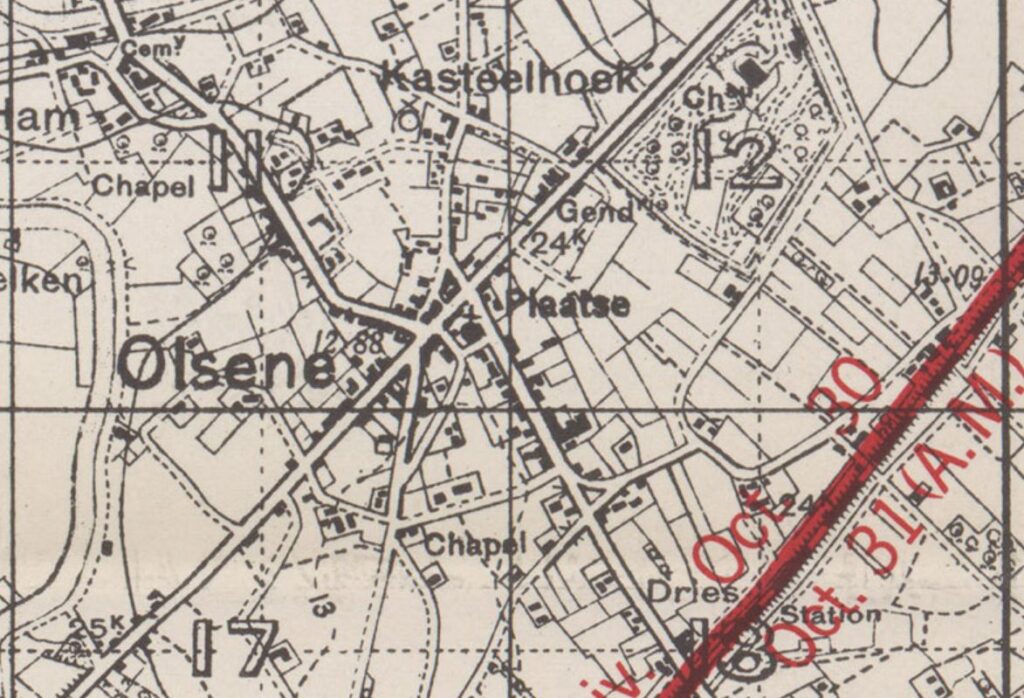
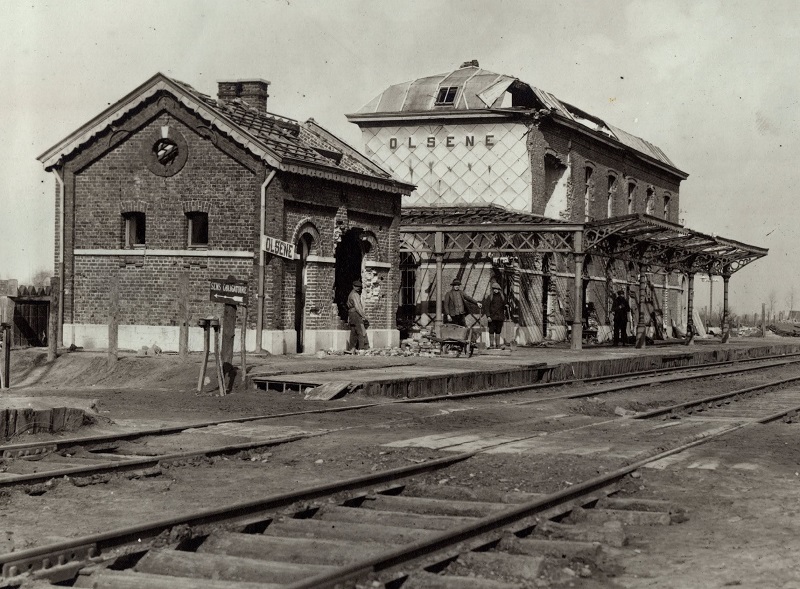
On the night of October 30-31, 1918, the 37th Division relieved the French 132nd Division on the front line south east of Olsene, Belgium. An operation was ordered to be launched on the morning of October 31, 1918 with the Escaut (Scheldt) River to the north as the final objective. The 37th Division, in which the 136th Machine Gun Battalion was attached, would attack the Germans with the French 128th Division to the right, and the French 12th Division to the left. The Germans started a general withdrawal on November 1 with the 37th Division following in pursuit. The following incident was provided by the historian of the 136th Machine Gun Battalion:
“Our company went ‘over the top’ on the morning of 31 October, near the Château de Olsene [see the “Chau” above the No. 12 in the top left quadrant of the map], from positions along the railroad tracks about 900 meters from the enemy front line. The advance was begun under a rolling barrage furnished by the French guns in support. Sergeant Demmler commanded a squad of the First Platoon whose guns were in support. Promptly at 5:30 the advanced was begun. The Platoon had a little more than cleared the railroad when they were caught in the German counter barrage, shells falling everywhere, and making any attempt at taking cover worse than useless [see photo of the area below]. About 75 meters beyond the tracks, Sergeant Demmler was struck by pieces of an exploding H.E. [high explosives] that fell in the midst of the squad he lead. Corporals Leo A. Damicon and Felix L. Marlett stopped and offered aid and assistance to a place where medical attention could be had, but to each his answer was the same, “Keep on with the advance, they need everyone of you up ahead.” Sergeant Demmler was found by runners returning to the Company and carried to the Olsene dressing station. Three days later he died in the hospital. The splendid record of this brave soldier has won the admiration of all who knew him.”
Jump off location for the 136th Machine Gun Battalion on October 30-31, 1918, Olsene Belgium. The red line runs along the railroad track.
Dries Station in 1919 (left) indicated on the above map near the jump off position. The terrain advanced by the 37th Division (right) located near the jump off point.
On November 2, 1918, Fred Demmler died of his wounds in Hospital No. 5 in Staden, Belgium and was buried the next day in a temporary gave. On June 5, 1919, he was disinterred and reburied in the American military cemetery in Waregem, Belgium. At the request of his family, his remains were returned to the United States and were received by his family on May 12, 1919. The funeral service was held in the Smithfield Cemetery in Homewood under a tent erected by the pastor of Saint Paul’s Evangelical Lutheran Church where Demmler was a member. His six brothers served as pallbearers for their fallen brother.
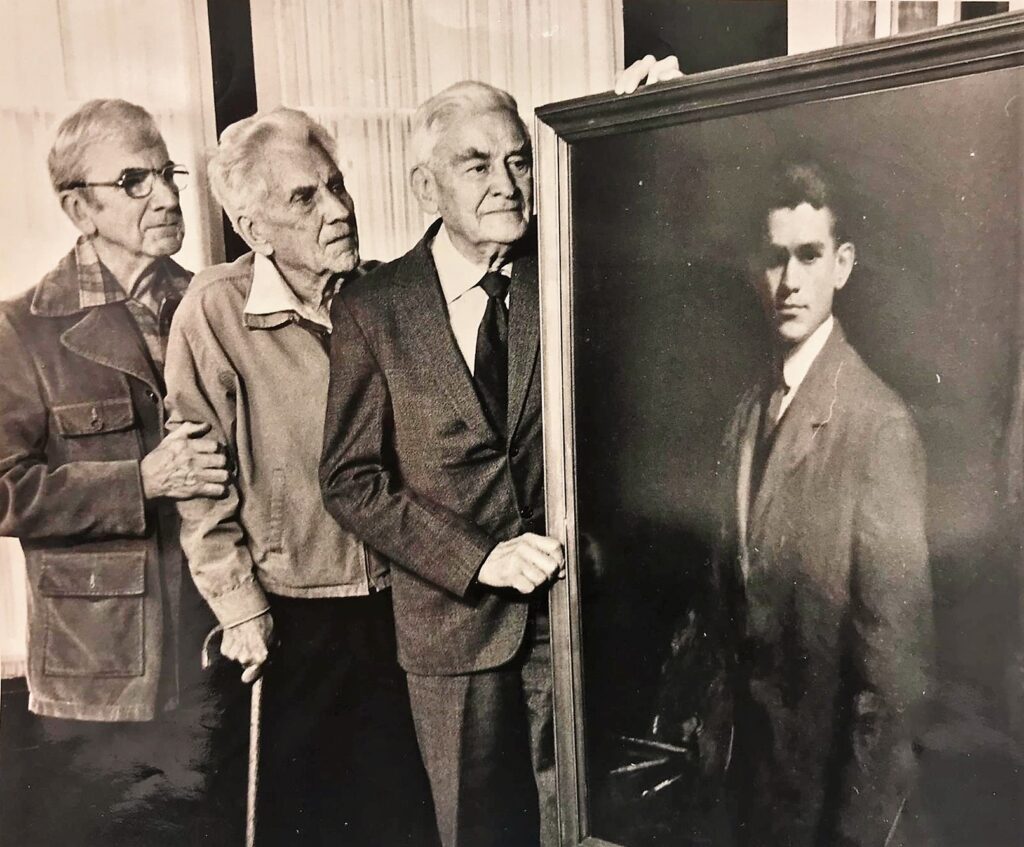
Brothers (L-R) Alfred, Harry, and Oscar Demmler admiring the self-portrait of Fred A. Demmler. Photo credit: Pittsburgh Post-Gazette; Source: Facebook community @FredADemmler
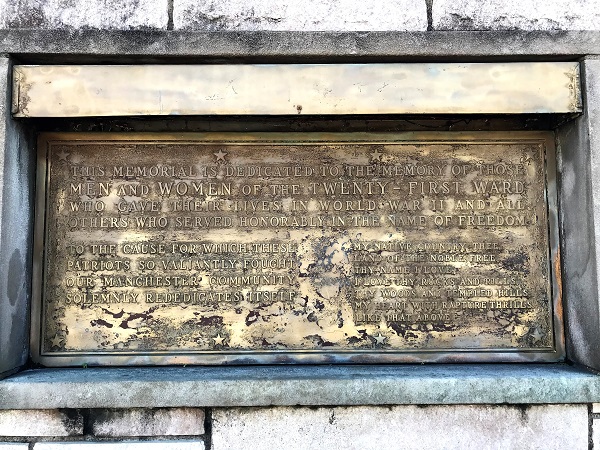
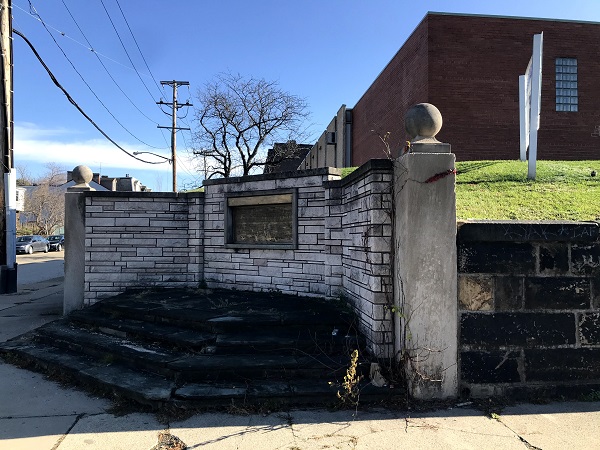
About 1925, Edward & Minnie Demmler sold their home in Manchester and relocated to the Ben Avon neighborhood of Pittsburgh. Their home at 1522 Chateau soon became the Manchester Educational Center where meetings and lectures could be held, but also a place for young artists in the community to come an create art and drama. In 1944, Samuel Ely Eliot, the cousin of poet T.S. Eliot, was Executive Director of the Manchester Center and chaired a committee to have a memorial plaque installed at the corner of Chateau and North Franklin that reads in part, “Dedicated to the memory of those all men and women of the Twenty-first Ward who gave their lives in World War II and all others who served honorably in the name of freedom.”
The World War II Memorial dedicated to the Men and Women of the Twenty-First Ward is located at the corner of Chateau and N Franklin Streets in the Manchester neighborhood (Northside) of Pittsburgh.
Why have I detained you for a tale so plain? What was he but an obscure young painter, thirty years old, with his way to make? Why should I point him out to you among the millions?
Because he was my friend? No. Because he is yours. Because I thought I saw in him the seeds of greatness? No. Because the seeds of greatness which were in him are in you; and he shall make you see them. I give him to you young men to be your friend, loyal and high minded. I give him to you young women to be your lover, clean of body and of soul. He will be worthy of your friendship and of your love, and you shall be worthy of his in return.
He is to be immortal. And it is you who must make him so. Let him kindle in your hearts a fire which will not go out. He that would have made great canvases glow with the might of his spirit and the splendor of his imagination shall not now live by art alone, but by the living deeds of you. You shall be his masterpieces. You, immortal youth, shall be his immortality.”
Lucien Price Immortal Youth: A Study in the Will to Create
Pitt Football Coach Killed-in-Action
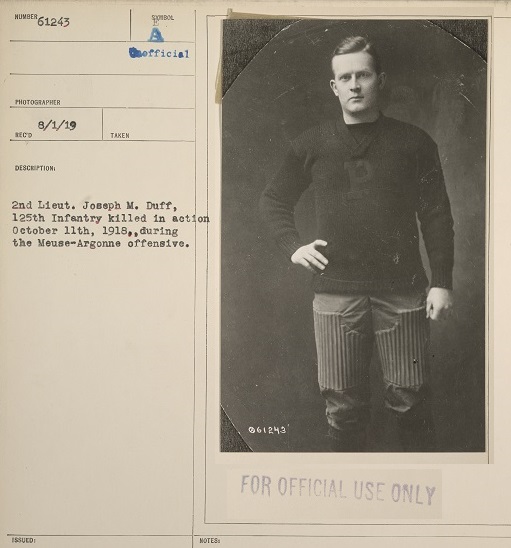
Joe Duff was destined to lead men. But like so many brilliant young men of their time, his life was cut short on the killing fields of the Meuse-Argonne. Duff was not only an All-American football player, he was an American hero. Joseph Miller Duff Jr. was an Ivy League graduate, the Head Football Coach for the University of Pittsburgh, an attorney for the Allegheny County Bar in Pittsburgh, and a World War I machine gunner. Joe Duff was an American hero. Despite being rejected by the Army on three different occasions for medical reasons, Duff was determined to serve his country and was eventually able to convince the local draft board to overlook his vision problems. Duff was a 1912 graduate of Princeton University. As a standout player on their varsity football team, he was named a 1911 ‘All-American’ and proclaimed to be one of the ‘greatest guards in football history’ according to a 1913 Pittsburgh Press newspaper article.
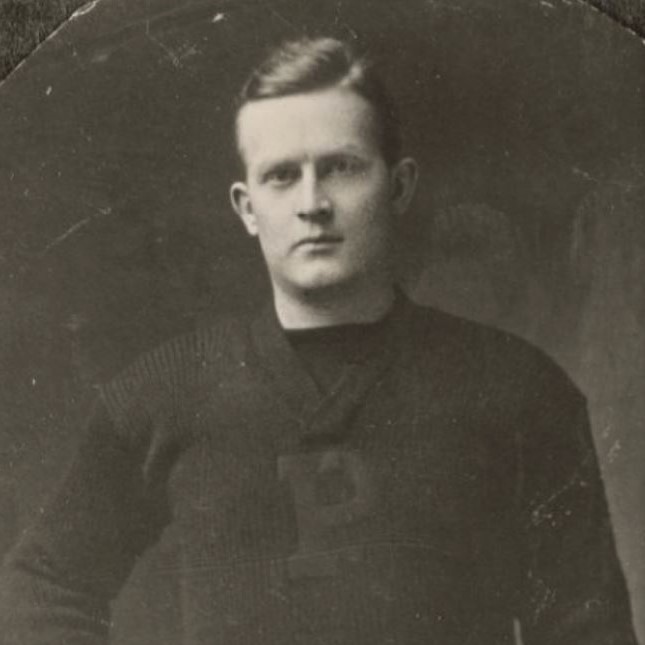
Joe Duff in his Princeton football uniform circa 1912.
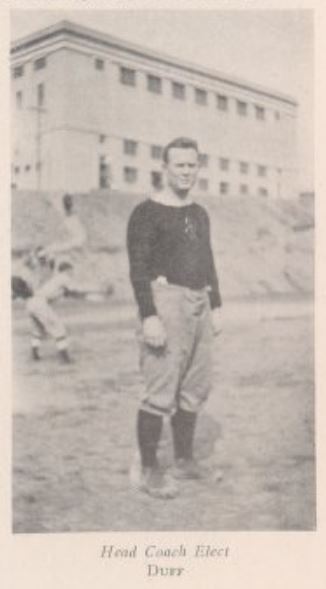
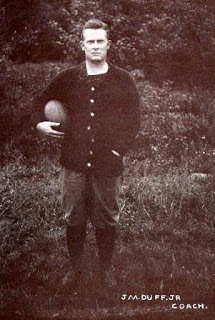
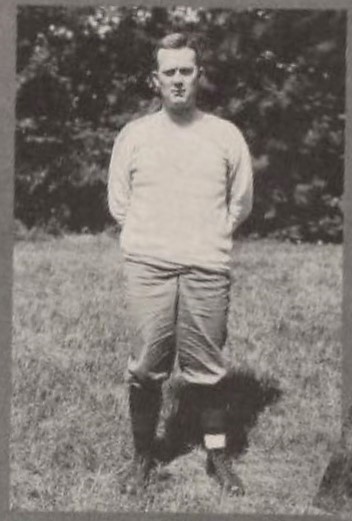
After graduation, he was asked to stay on at Princeton to serves as an assistant football coach. The following year he received an offer to become the head football coach at the University of Pittsburgh. Duff delivered two winning seasons for Pittsburgh in 1913 and 1914. Following the 1914 season, Pitt found an opportunity to hire legendary coach Glenn Scobey “Pop” Warner. Coach Warner helped Pitt win the College Football National Championship in 1915. That same year, Duff obtained his Law Degree from the University of Pittsburgh and went on to work in his brother James Duff’s law firm. At the time of the national draft registration, Duff was already a college graduate. He enlisted in the Military Training Association and was situated at the Reserve Officers Training Camp at Fort Niagara in June 1917. At the end of his training at Fort Niagara, NY, he was not assigned to a specialized unit as many of the other candidates listed on the roster. His vision problems likely kept the Army from granting him a commission.
Photos that appears in the University of Pittsburgh “The Owl” publications (1914, 1915, 1916). digital.library.pitt.edu
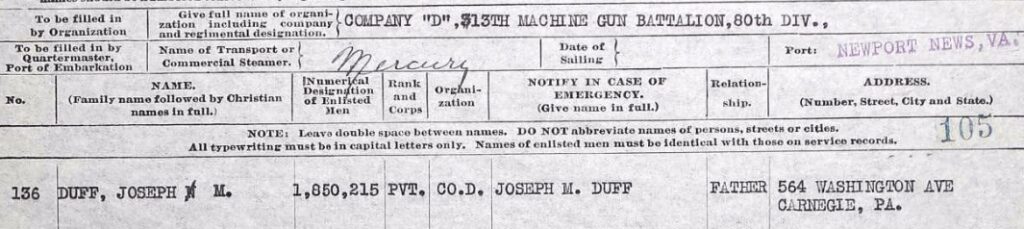
In December 1917, Duff worked as an attorney for the United States Justice Department and was responsible for prosecuting men who attempted to evade the draft, the so-called “slackers” as they were often called in the newspapers of the time. However, this role as a government prosecutor did not protect him from being called up under the terms of the Selective Service Draft. When his draft number was called in Carnegie, PA, he took the opportunity to persuade the draft board to waive his medical condition and allow him to be inducted into the Army. He was sent to Camp Lee, Virginia in March 1918 and joined with Company D of the 313th Machine Gun Battalion, 80th Division. Duff set sail with the Battalion aboard the USS Mercury in May 1918 as a Private. In less than one month he was promoted to Corporal. His prior military training to become an officer at Fort Niagara surely made Duff stand out among the other men. Duff was soon promoted to the rank of Sergeant as part of his machine gun battalion.
His tenure with the 313th Machine Gun Battalion took him into action in part of the Artois Sector of France from July 23 to August 18, 1918, and in the Saint Mihiel Offensive Corps Reserve from September 12 to 16, 1918. During my research for the book “Good War, Great Men.” I uncovered letters written by Duff’s commanding officer that revealed this officer’s fondness for Sergeant Duff. Commanding Company D was Captain William George Thomas, a 1909 graduate of the University of North Carolina at Chapel Hill. Thomas was the former captain of their UNC varsity football team and recognized Duff within the ranks of D Company. Thomas wrote letters home recalling that Duff was once hired by UNC to coach their football team (1915 season).
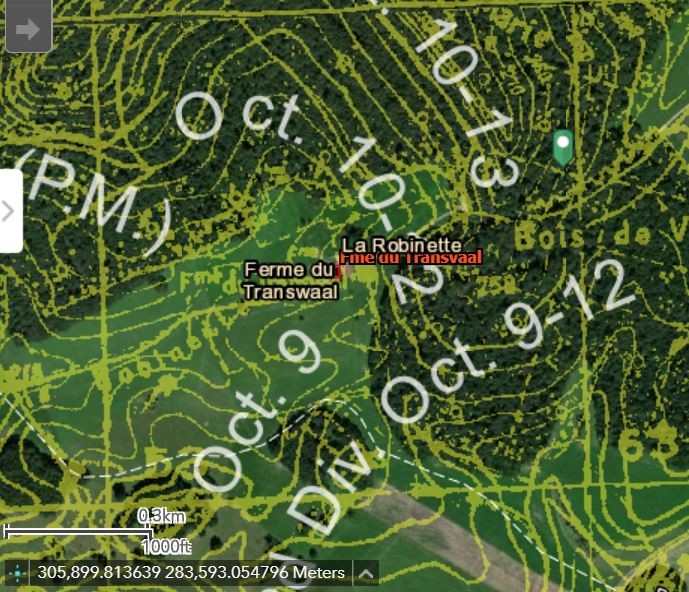
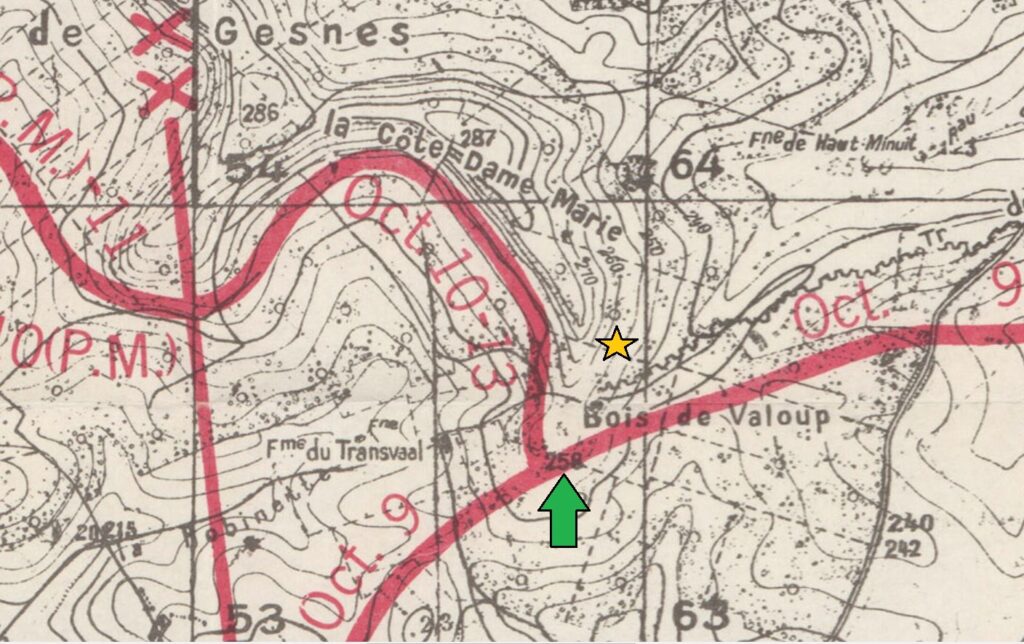
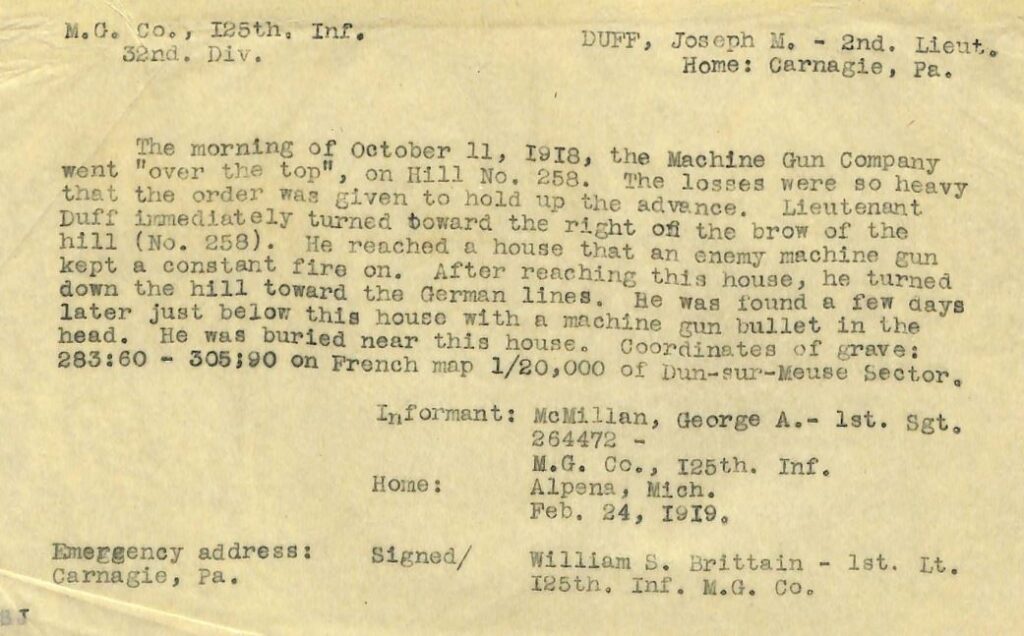
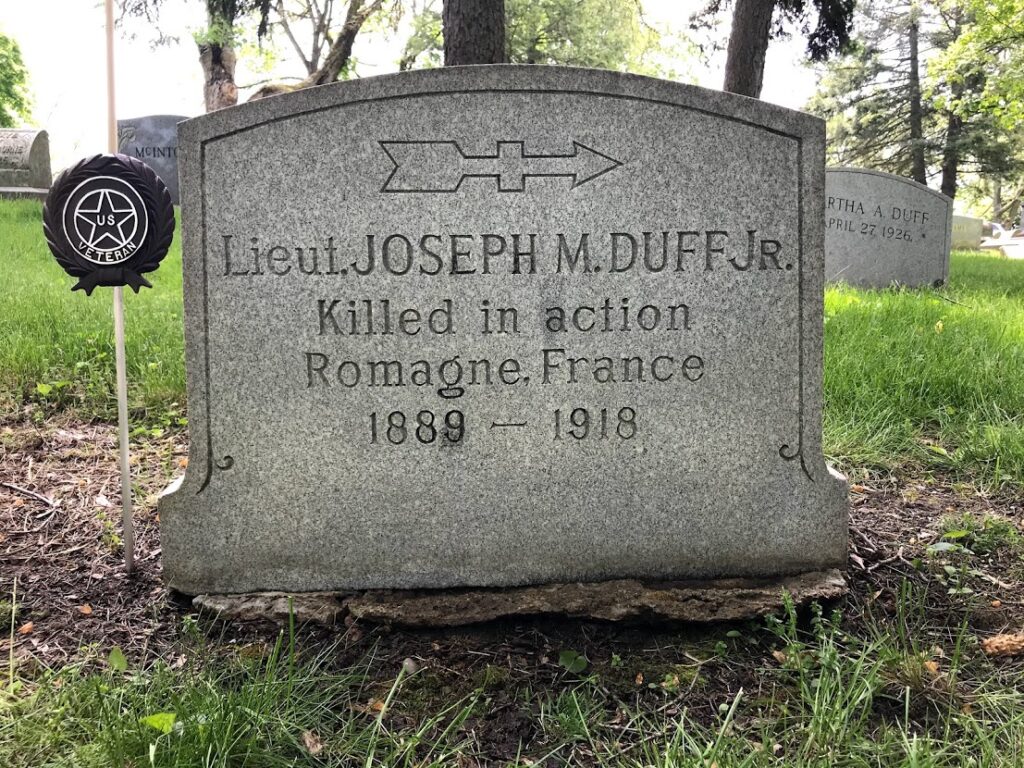
The officers of the A.E.F. were frequently being asked to provide recommendations for men within their ranks who could be sent to officers training camps in France to lead other men. Captain Thomas recommended Duff for officers training, and on September 30, 1918, Joe Duff accepted his commission as a Second Lieutenant and was assigned to lead a machine gun company in the 32nd Division, 125th Infantry. After only ten days with his new unit, Duff was killed while fighting at Gesnes-en-Argonne, part of the Meuse-Argonne offensive. His ‘Red Arrow Division’ engaged German troops east of the Meuse River until the Armistice was signed. The 32nd Division suffered a total of 13,261 casualties, including 2,250 men killed in action during the war, making it third in total number of battle deaths among all U.S. Army Divisions. Duff’s body was buried in a temporary gravesite on Côté Dame Marie in Romagne-sous-Montfaucon, France.
Lieutenant Duff’s brother, Captain George M. Duff, a Chaplain serving in France with the 305th Infantry, sent a telegram back home to his brother James to notify the family of Joseph’s death. The remains of Lieutenant Duff were returned to the family about three years after his death and a funeral service was held on September 9, 1921, at the First Presbyterian Church in Carnegie, Pennsylvania. Duff’s brother George, then pastor of the First Presbyterian Church of Elwood City, presided over the funeral and his remains were interred in the Chartiers Cemetery in Carnegie, Pennsylvania. The symbol on the top of the headstone represents the 32nd “Red Arrow” Division for which he served in World War I.
His brother James H. Duff later become a prominent figure in Pennsylvania politics and served as the 34th Governor of Pennsylvania from 1947-1951 and also a United States Senator from Pennsylvania 1951-1957. Brother George M. Duff served as pastor of the Riverdale Presbyterian Church (Riverdale NY) from 1922 – 1954. The Manse located on church property was renamed the Duff House in honor of George M. Duff, and is listed on the National Register of Historic Places.
Joe Duff was truly an ‘All American’ in every respect, and it is with great honor that we remember his sacrifice during the Centennial Anniversary. In May 2019, Mr. Dominique Lacorde took me to the location where Joseph M. Duff Jr was killed and later buried. The Rev. Joseph M. Duff Sr traveled to Gesnes-en-Argonne in July 1920 to this exact spot. He later wrote this passage in his book A Gold Dollar, Studies in Nature and Life.
“Joe’s men, from the shelter of their fox-holes, anxiously watched him go forward, revolver in hand, crouching, round a little black house that still stands on the crest of the hill, and disappear on the other side. The minutes passed. He did not return. Two days later they found him, a hundred feet beyond. He had been caught in the hail of fire that swept the hillside, and instantly killed.
I walked over the top of the hill, round the little black house, and a hundred feet beyond. I reached the spot. It was strangely blank and meaningless. There was nothing to see but a mass of undergrowth. There was not a footprint. There was not a scar of shell. There was no human association, save a yellow raincoat flattened out on the ground. I could not believe that the scene of an intimate event, whose dark shadow had fallen three thousand miles away, could give me on the spot no trace of it, no message from it. A gaunt great oak near, with a shell-broken limb dangling at its side, seemed the sole witness that a tempest of fire had swept the hillside.
Adding to my surprise was a curious, brooding silence. There was neither voice, nor twitter of birds, nor rustle of leaves, nor even the break of padded feet of a scared rabbit scurrying out of the bush. I had noticed before, an absence of sounds in the fields and roads and in the village streets.
The stillness of the thousands sleeping in their quiet graves in the great cemetery had seemed to spread like a contagion over the entire countryside. But here on the battlefield, where had roared such thunder as hardly ever had been heard, the silence was eerie, as if the ghostly guard of the place had commanded it. Nature here, in shrub and tree and rock, stood rigid and still with her finger on her lips. Where war had loosed all her frightful voices, the only sound I heard was the faint rasp of a hoe in a ploughed field near, where a patient peasant, with his little daughter, was back at his toil.
I stood there so disappointed and benumbed, without even the poignant stab of pain which was my due where my boy had suffered, that to break the spell, I took from my pocket the letter of the regimental chaplain written on the day he buried him, and read it once again.”
Transvaal Farm located on the southern slope of Côte Dame Marie.
The First Aviators
Pittsburgh can be proud of one of its own citizens playing an important part in the early days of the Great War, and notably, becoming the first American to receive the French Légion d’honneur (Legion of Honour), the highest military award given by the French Government. The honor itself dates back to the time it was first established by Napoleon Bonaparte in 1802. The gentleman credited with this distinction was a young man from Pittsburgh named William “Bill” Thaw II.
Lieutenant William “Bill” Thaw II – Library of Congress Control No. 2014701919
Thaw, only 21 years old when the war began, put himself in harm’s way numerous times to assist the French in their fight against Germany. He started the war in the trenches volunteering as an infantry soldier, flew in a French aero squadron, and ended the war representing the United States as a decorated American aviator. So how did a 21-year-old Pittsburgher get into such a situation? In his case, he volunteered for the service.
Thaw was born into a wealthy Pittsburgh family. His grandfather, William Thaw Sr. made his fortune in canals, the coke industry, and railroads. His father Benjamin Thaw, managed his late father’s estate and was himself a successful banker and trustee. His mother, Elma Dows Thaw, kept the family residence in the Squirrel Hill North neighborhood of Pittsburgh at Moorewood Place. The dwelling no longer exists, but it would have been located on the present-day grounds of Carnegie Mellon University (the Greek Quad). The Thaw Family also had a residence in New York City where the family would often spend time.
Bill Thaw dropped out of Yale in his sophomore year, took flying lessons, and began a small business/hobby of flying passengers in New York City, once even flying his Curtiss hydroplane under four of the bridges located on the East River without touching the water. When the war began in 1914, Bill Thaw was already in France. He was there to compete in an organized race of seaplanes known as the Schneider Cup. Thaw donated his plane to the French War Department and offered his services to the French air service, but his initial offer to serve was rejected. Undeterred, he enlisted in the French Foreign Legion and served in the battlefront trenches for several months. An American correspondent with the volunteers wrote about their experiences in November 1914, “The second line trenches are rather more comfortable than the ones we have had before, as they have a fire in them. We got many good things in the shape of food that evening. It is reported that tomorrow we are going for a rest where we hone to find baths. Life is the same day in and day out. Nevertheless, it is exciting because of the danger in the presence of the inevitable shell.”
William Thaw (pictured on the right) in his Curtiss Hydroplane. Pittsburgh Press, Aug 26, 1914 – Page 16
Life in the trenches did not give the young Thaw the pace of excitement he was seeking and he made his way to convince the commander of an aero squadron for an opportunity to transfer into that unit where he could provide his aviation knowledge and skills. Thaw was granted a transfer out of the French Foreign Legion and into a French aero squadron, given the role of a “soldat mitrailleur,” or soldier machine gunner. This placed him as an observer in a plane where he carried a pistol and machine gun as the pilot made runs to spot enemy movements (machine guns were not yet mounted). Some descriptions of his activities at this time report that this role as an observer-gunner inside the plane may have likely made him the first American to take part in aerial combat during the war. Thaw would serve in this role for a year, commended for his abilities, and eventually become the first American to be promoted a “sous lieutenant” or second lieutenant in the French military. Thaw was finally able to prove his flying abilities to the French superiors and was permitted to puts his flying skills to the test.
Thaw would partner with another American volunteer, Norman Prince, the son Frederick H. Prince, a wealthy American banker from Massachusetts. These two young men joined forces, with the support of other Americans sympathetic to the French fight against Germany. They convinced the French War Department to give the young Americans a chance to fly as their own squadron. The French word for a squadron is ‘escardon or escadrille.’ In 1916, a year before the United States entered the war, the French Government approved of the American volunteer squadron, under the leadership of a French commander, to form the “Lafayette Escadrille.” The name Lafayette used in honor of Marquis de Lafayette, the French military officer who came to America to fight in the Revolution.
Most people familiar with the topic of World War I have undoubtedly heard the phrase “Lafayette, we are here,” words that were said to have been spoken at Lafayette’s tomb when the United States arrived in France in 1917. These few words were an echo of the sentiment as to why the Americans were there to help the French people. In 1825, Marquis de Lafayette was actually in Pittsburgh on a tour of the United States. He was the guest at a reception given by Mayor Charles Shaler. Lafayette had this to say: “So, in the very time of the revolution, Pittsburgh has proved very interesting to us as a military post, nor can I recall those transactions, without gratefully remembering that my name has been associated with its military existence as a fort.” Lafayette was referring to a colonial fort that was located near present-day Penn and Ninth Streets. He was undoubtedly proud to have had his name attached to a military fort in Pittsburgh, and 92 years later, a young man from Pittsburgh would attach his name to another military entity, representing a group of Americans looking to honor and return the favor of his deeds.
Perhaps the pinnacle of William Thaw’s performance as an aviator came when the French government bestowed upon him the “Chevalier of the Legion of Honor.” The citation reads, “A volunteer for the duration of the war. A pilot remarkable for his skill, his spirit and contempt of danger. Has recently delivered 18 aerial combats at short distance. May 24 at daybreak he attacked and destroyed an enemy plane. The same evening, he attacked a group of three German machines and pursued them from four thousand meters of altitude down to one thousand. Painfully wounded during the combat, he succeeded, thanks to his daring and his energy, and bringing into our lines his gravely damaged aero plane and landed normally. Already twice cited in the Order of the Army. This nomination carries with it the Croix de Guerre with palm.”
One of the more striking photos that I have seen of William Thaw in France is when he is surrounded by members of the Layfette Escadrille, holding an American Flag that was made by employees of the US Treasury Department. The flag was passed to the French Ambassador via Eleanor Wilson McAdoo, daughter of President Woodrow Wilson. Her husband was Secretary of the Treasury William Gibbs McAdoo. Thaw is pictured here wearing his French uniform. However, once the US entered the war, the Lafayette Escadrille would later become the 103rd United States Aero Squadron. The photo that follows shows Thaw in his uniform for the United States where he would eventually be promoted to the rank of lieutenant colonel.
Lt. William Thaw holding the American flag made by U.S. Treasury employees. National Archives Identifier: 31480618
After the war, Lt. Col William Thaw returned to Pittsburgh and married Marjorie E. Priest in 1921. The couple lived in the Schenley Apartment (now a dormitory for University of Pittsburgh students). He went into the insurance business but died prematurely in 1934 of pneumonia at just 40 years of age. He is buried in Allegheny Cemetery in Lawrenceville.
Bill Thaw lost his younger brother who was also serving during the war. Alexander Blair Thaw was an aviator in France and was killed when his plane was caught in some wires and the aircraft crashed to the ground on top of him. I will explore Alexander Blair Thaw’s service in a separate article.
There is no shortage of material available to read about the Lafayette Escadrille and William Thaw II. My goal here was to introduce the topic of this Pittsburgh aviator to anyone unfamiliar with his story. He was indeed an interesting man who played a vital role in a noble cause. Please take a look at the YouTube video about the “Lafayette Escadrille.” I’ll end this article with an observation by Edwin C. Parsons, a former French Foreign Legionnaire and WWI pilot who served with Thaw. “Bill was without question the most striking and popular figure on the front. There was never a dull moment in his company. It seemed as if there weren’t a man, woman or child from Dunkirk to the Voges who didn’t know ‘Meester Beel Taw’; not only know him, but love him.”
Lt. Col. William Thaw, pictured here in a pencil drawing by Henri Farré. Image was released by the United States Air Force with the ID 141006-F-DW547-001
Finding Private Enright
The following article was written by the late Michael Connors, Pittsburgh Historian and former vice-president of the Lawrenceville Historical Society. It appeared in the Pittsburgh Post-Gazette on November 9, 2007.
The Saturday before Veterans Day, 1984, I was driving through Stanton Heights. I came across the entire contents of a house piled along a curb. Being an antique collector, I pulled over to investigate. On top of an end table covered in the season’s first snow, there was some sort of placard. Signed by Gen. John Pershing, it commemorated the service of Thomas Enright, one of the first battle casualties of World War I. He was, moreover, born and raised in Pittsburgh. It was a historical fact that fired my imagination. I launched a quest to piece together the life of Thomas Enright, the Army private from Bloomfield who was a national symbol of America’s war sacrifice.
Thomas Enright was born May 8, 1887, on Taylor Street in Bloomfield. He was the seventh child (fourth surviving child) of Ellen and her considerably older husband, John Enright. Thomas was their first child not born in their native Ireland. He spent his youth on Taylor Street. While the construction of Soldiers & Sailors Memorial Hall was under way, a few weeks before the start of the 1909 World Series, Enright enlisted into the very small U.S. Army. It was the inaugural season of Forbes Field when Honus Wagner and the Pirates defeated the Detroit Tigers led by Ty Cobb. By the end of his second enlistment and return to Pittsburgh, Enright had an impressive record. He had been to China, post-Boxer Rebellion. He had earned the title of expert cavalryman, fighting Moros in the Phillippines. In 1914, as part of the 16th Infantry, Enright was one of the troops in Vera Cruz harbor when seaman Francis DeLowry was shot from the mast of the USS New Hampshire. DeLowry had been a classmate at St. Mary’s in Lawrenceville. In 1916 Thomas Enright was back in Mexico. Though he wrote to his sister Mary of seeing nothing but starving cattle, he was part of the Pershing-led punitive expedition in pursuit of Pancho Villa. After a short time back in Pittsburgh, perhaps out of a sense of duty, hearing talk of U.S. involvement in Europe’s war — or a good look at his brothers’ lives as industrial laborers — Enright re-enlisted. He rejoined the 16th Infantry stationed in Fort Bliss, Texas, just in time to be sent back across the country by rail to Hoboken, N.J. The 16th Infantry, 2,600 strong, not unlike the rest of the Army, was made up largely of new enlistments. Many were expecting a Boy Scout-type adventure. That adventure began with a two-week crossing of the Atlantic Ocean as part of the very first troop convoy. On June 26, 1917, they disembarked in St. Nazaire, France, as part of the First Infantry Division. Their chief of operations would become well known to history — it was George C. Marshall of Uniontown. The First would come to be known as “Pershing’s Darlings.” The best damn division in the Army, Pershing would call them. When the French government requested a U.S. military presence for a Fourth of July ceremony, Pershing ordered Enright’s battalion from the 16th to Paris. “The first appearance of American combat troops in Paris brought forth joyful acclaim from the people,” wrote Pershing in his memoir. At this occasion, a U.S. officer to declared — to acknowledge France’s key role in the American Revolution — “Lafayette, we are here!” (It’s possible that Pershing himself uttered it.) Four months after that proclamation, the U.S. Army was for the first time at the front. Company F, 16th Infantry, to which Enright belonged, had been in the trenches only a few hours. The Germans were aware of their presence, having been informed by a French deserter. A little after 3 a.m. on Nov. 3, 1917, the Germans launched a nearly hour-long “box assault.” This was an artillery assault to the left, right and rear of Company F’s position, cutting them off from reinforcements or retreat. Across a frozen no-man’s land, 200 seasoned German shock troops advanced with the odds 10 to 1 in their favor. Eleven men of Company F were taken prisoner. Five others were left wounded. Pvt. Merle Hay, Cpl. James Gresham and Thomas Enright were killed. Hay was shot, stabbed and stomped to death. James Gresham was shot between the eyes. A few yards away lay Thomas Enright, expert cavalryman, face down, his head nearly severed from his body by a trench knife — a 20th-century weapon little improved upon since the days of ancient Rome. Scattered in and about the trench were a few German helmets and rifles. The Pittsburg (as the city was spelled at the time) Press quoted a French general: “You fell facing the foe in a hard, desperate hand-to- hand fight.”
On Nov. 5, 1917, Enright, Gresham, and Hay were buried in the country where they had died, with the following inscription to mark their graves in the Lorraine region: “Here lie the first soldiers of the illustrious Republic of the United States who fell on French soil for justice and liberty.” The deaths of these three men would solidify the country’s resolve, becoming a notorious episode in U.S. military history. Enright, Gresham, and Hay were no sons of privilege. They could have been any farmer’s or millworker’s boys. There was a spike in war bond sales. Cheeks stained with tears, soldiers fired large French 75s (artillery pieces) in the direction of the German lines with “a prayer they would hit their mark,” wrote The Pittsburg Press. A banner headline from a local paper on Nov. 5 was “Huns Kill Local Youth.” At the election night smoker of the Pittsburgh Commercial Club, plans were laid for raising funds to build a memorial to Enright. Every person in the city would be asked to contribute the number of pennies corresponding with their age. Councilman John S. Herron introduced a resolution to rename Premo Street in Morningside, where Thomas’ sister Mary lived, “in honor of the dead patriot.” “I know that if he had a moment of consciousness before death came, he was glad to go the way he did,” the papers quoted Mary. Mary wired the War Department asking for Enright’s body to be returned, as did Mayor Joseph Armstrong and the United Spanish War Veterans. Despite their requests, Thomas Enright would lie in a French grave for over two years after the Armistice was signed.
On July 10, 1921, on the same Hoboken Pier from which Thomas Enright and his comrades had departed, Gen. John “Blackjack” Pershing stood straight and square to greet the transport ships Wheaton and Somme, which carried the bodies of Thomas Enright, James Gresham and Merle Hay. More than 7,000 flag-draped coffins were unloaded from the two ships. When carried onto the embarkation pier, they stretched row upon row. Never comfortable as a public speaker, Pershing spoke with measured voice but with visible emotion: “These men who died on foreign soil laid down their lives for us. They fought for freedom and for eternal right and justice, as did the founders of the great American Republic before them. “They gave all, and they have left us their example. It remains for us with fitting ceremonies, tenderly with our flowers and our tears, to lay them to rest on the American soil for which they died” Pershing gently laid a wreath on the coffin of Gresham, Hay and Enright. On July 14, Enright’s casket arrived in Pittsburgh at Pennsylvania Station, accompanied by William Wiggans, one of the very few of Company F to have survived the box assault intact. Comrades of various veteran organizations and a squad of motorcycle policeman were present. The body was taken to the home of Enright’s sister, Mrs. Charles Trunzer, in West Etna. The following day, Enright’s casket was delivered to Soldiers & Sailors Memorial Hall where, like Francis DeLowry before him, he lay in state. Throughout the day, a steady stream of mourners arrived, not only those who knew him, but those who knew him only as a rallying cry. Dozens of floral arrangements were delivered. On Saturday, July 16, Enright’s flagdraped casket was carried on the shoulders of his pallbearers through the front door of Soldiers & Sailors Hall. All were alumni of St. Mary’s school and veterans of the Great War. Enright was carried down the long walkway and placed on a gun caisson drawn by six horses and taken to St. Paul Cathedral for the service. During the formation of the procession, headed by a detachment of 500 ex-servicemen from the Pittsburgh police and fire departments, “the great crowd stood in silent tribute … many wept unashamed,” The Pittsburg Press reported. The cathedral could not accommodate the overflow crowd. Thousands crammed their way inside, filling the aisles. Most waited outside while a Mass was said by Bishop Hugh C. Boyle. From Oakland, the procession made its way to St. Mary’s Cemetery in Lawrenceville, where after multiple conflicts and thousands of miles, Private Thomas Francis Enright was buried again, not far from where he had been born. Pershing’s wreath was laid upon the freshly mounded earth.
If the Pittsburgh Commercial Club did collect pennies, the Enright memorial was never built. However, the Enright Theater was dedicated on a pleasant, unseasonably mild Saturday in December 1928 more than 11 years after his death. A parade launched the opening ceremonies for the theater. The 324th observation squadron flew their PT Army planes low across the sunny sky dropping wreathes upon the theater’s roof. Thomas’ sister raised the flag to the top of the gleaming new flag pole, while the 107th field artillery drum and bugle corps from Elizabeth played the national anthem. The civic-conscious crowd stared in disbelief as the first volley shattered the windowpanes of the new box office. The last 20 cannon blasts broke dozens more windows, roaring implacably on over the screams of police and populace. In a span of less than 30 years, all of the theater’s windows would be broken again. This time intentionally and for good, the flagpole from where Old Glory had been raised would be razed by urban planners. By the time of the demolition of the Enright Theater, Enright’s tombstone had become worn and illegible — due in part to the quality of Pittsburgh’s air. On Memorial Day, 1961, through the efforts of VFW Post 897, headed by Commander Joseph Borkowski, a new stone was unveiled. Some residents of Premo Street objected to Councilman Herron’s proclamation to rename the street. Today, Premo Street is Premo Street. Along the border of East Liberty and Friendship, roughly two blocks west of the site of the Enright Theater, today sits Enright Parklet, discernible by a piece of wolmanized lumber fashioned into a sign. The swingset and slide is too small to be a park. Thus “parklet.” Off Broad Street in East Liberty is Enright Court, a group of homes built during the urban revitalization that tore down the theater and created the East Liberty circle. There is irony in the city having named a dead-end street for Enright. I asked several residents of Enright Court who had spied me looking at their street sign if they knew who, or what their street was named for. They had no idea.
First Americans to be Killed
It would be impossible to reflect on Pittsburgh’s involvement in the Great War without including a bit of history surrounding Thomas Francis Enright, one of the first Americans to be killed during the war. Enright was born and raised in the Bloomfield neighborhood of Pittsburgh, joined the Army prior to the United States’ involvement in the war, got out of the Army, but then re-enlisted when the United States declared war with Germany. Enright was killed on November 3, 1917, along with two fellow soldiers of Company F, 16th Infantry Regiment, First Division; James B. Gresham from Evansville, Indiana, and Merle D. Hay from Glidden, Iowa. These three men were the first Americans to be killed in the Great War.
Despite the notoriety that would be attached to these three men, an honor not wished upon by anyone, their deaths would apparently ignite a surge in the Liberty Bond drive and sharpen the Nation’s frame of mind of ensuring that its citizens were getting behind the war effort. I would venture to guess that the people of Western PA read about Enright’s death in the newspaper, learning about how the Germans overpowered the Americans in their trenches, used brutal hand to hand combat to commit their deed, and learning that some of the soldiers in the unit had been taken prisoner during the incident. It undoubtedly struck an emotional chord with many, possibly feeling that personal connection with a local boy and relating it to someone they knew who was about to head overseas to fight. I believe it may have also been the reaction to how the French people responded to the death of these men, and their subsequent burial. Several efforts have been made over the past century to ensure that future generations in both the United States and France would honor and remember Private Thomas F. Enright and the “First Americans to be killed.”
The Enright family lived at 414 Taylor Street in the Bloomfield neighborhood of Pittsburgh. Thomas Enright was 14-years-old when his mother Ellen Hern Enright passed away at the age of 49. In 1913, his father, John Enright, died in Saint Francis Hospital of pneumonia following a streetcar accident that fractured his neck and femur. Enright’s first enlistment in the Army occurred on September 15, 1909, at 22 years of age. Enright was serving in the Army in 1914 when his childhood friend from Pittsburgh, Francis DeLowery, was killed in Mexico while serving with the Marines. The Veterans Administration Master Index card for 1917 has his address at 80 Dewey St, West Etna, the home of his sister Johanna Trunzer. Enright reenlisted in the Army on April 6, 1917, the day the United States formally declared war against Germany. When the Army reported Enright’s death in November 1917, his sister Mary Irwin was living at 6641 Premo Street in Pittsburgh. She talked to the Pittsburgh Press shortly after learning about her brother’s death and said that he had enlisted “eight years ago,” referring to this 1909 enlistment. However, she reported that she had not seen him in at least 5 years. Pittsburgh City Councilman John S. Herron proposed in November 1917 of renaming Premo Street to Enright Street, but the measure never passed.
The address of Enright’s sister, Johanna Trunzer. Source: United States, Veterans Administration Master Index, 1917-1940.
The photograph of Enright’s first burial site in France has been shared extensively, and if you look closely, you can just make out Thomas Enright’s name at the base of the wooden cross with “Co F” written below his name. Although his remains are no longer in France, there are at least two memorials in France that honor and remember his service. One monument is located at the entrance to the Bathelémont cemetery. The history of the original monument placed to honor these three men is a fascinating story. In short, the first monument was placed in the center of Bathelémont, seen below in the postcard image titled “Americas First Offerings.” However, this first memorial would later be destroyed during the Second War, October 16, 1940, when members of the German Army dynamited the monument. A replacement monument was later installed and it presently sits next to the Bathelémont cemetery entrance. A more recent memorial was created in 2017 and has been placed in the location where researchers believe the men were killed. The location of the trenches was researched by the Jean-Nicolas-Stofflet Association for the purpose of placing the centennial marker seen below on Haut-des-Ruelles hill, in the municipality of Réchicourt-la-Petite. When the men were killed, their bodies were carried off the battlefield to the nearby village of Bathelémont and buried the next day.
Photo by the American Graves Registration Service (GRS) of the First Three Americans Killed in France.
In 1921, Enright’s body was disinterred and returned to the United States. On July 10, 1921, General Pershing presented a wreath to the fallen at a memorial service held at the Hoboken, NJ pier. The wreath placed on Enright’s casket would later appear in this photograph that was taken at Saint Mary Catholic Cemetery in Lawrenceville, Enright’s final resting place. A headstone was placed in the cemetery, but by 1938, it was apparently deteriorating to the point that Enright’s sister Johanna was pleading for a replacement marker to adorn her brother’s gravesite. About a decade after Johanna Trunzer’s death, Robert B. Laufer of Louisville, KY, a survivor of Company F, made a plea in the Pittsburgh Post-Gazette asking for a new marker, stating that the original was “so beaten by the weather and Pittsburgh’s infamous smoke and grime, that the inscription is barely legible.” In 1961, the stone marker that exists in the cemetery today was installed by VFW Post 897.
Saint Mary Catholic Cemetery, 45th and Penn Ave, Pittsburgh, PA = Section M, Lot 146, Grave 5
The memory of Thomas Enright was also honored when his name was attached to the theatre complex on Penn Avenue in the East Liberty neighborhood in 1928. The address at the time was 5820 Penn Avenue, Pittsburgh, but the building and theatre were razed and have since been replaced by new construction along Penn Avenue.
In 2007, Pittsburgh historian Michael Connors wrote a wonderful piece for the Pittsburgh Post-Gazette about Thomas Enright, which included in the heading, “Here is the story of a forgotten hero.” Not surprisingly, the more time that passes from the years of the Great War, the less Enright’s name is even remembered in modern Pittsburgh history as it was even a few decades after the Great War. And that is all the more reason that people like myself find it so important to share his story. If we can recall his name, recall his sacrifice, we can ensure that Enright and all the fallen from the Great War be honored and remembered.
My hope is that the memory of Thomas Francis Enright will continue to resonate with future generations of people from Pittsburgh, an ever so simple gesture to ensure that we do not forget this young man. Perhaps it will be the young student reading about the Great War in school for the first time, the young researcher scanning the web about stories of how Pittsburgh honored her heroes, or someone looking to pay a visit to the cemetery and the site of his burial. Nothing would inspire me more than to know that time was allotted in a person’s day to find his burial plot in Lawrenceville, only to stop and read his inscription, saying his name out loud, “Thomas Francis Enright, you are remembered.”
Continually on the search for stories about the Great War connection to Pittsburgh, I found it interesting to learn that on the day of Enright’s initial burial in France, a young officer from Western Pennsylvania was present to witness his burial. The officer was George C. Marshall, born in Uniontown, PA, then aide-de-camp for General Pershing. Marshall, a legendary figure in American history, recalled in his memoir some of the facts about the burial that took place on November 4, 1917. Marshall wrote that General Paul Bordeaux of the 18th French Division gave an “eloquent tribute to their service,” and Marshall asked General Bordeaux if he could write down what was said that afternoon. This is what was dictated:
“Men! These graves, the first to be dug in our national soil, at but a short distance from the enemy, or as a mark of the mighty hand of our allies, firmly clinging to the common task, confirming the will of the people and Army of the United States to fight with us to a finish; ready to sacrifice as long as it will be necessary, until final victory for the noblest of causes; that of the liberty of nations, of the weak as well as the mighty. Thus the death of this humble Corporal and these two Private soldiers appear to us with extraordinary grandeur. We will, therefore ask that the mortal remains of these young men be left here, be left to us forever. We will inscribed on their tombs: ‘Here lies the first soldiers of the famous Republic of the United States to fall on the soil of France, for justice and liberty.’ We will, therefore ask that the mortal remains of these young men be left here, be left to us forever. The passerby will stop and uncover his head. The travelers of France, of the Allied countries, of America, the men of heart, who will come to visit our battlefield of Lorraine, will go out of the way to come here, to bring to these graves the tribute of their respect and of their gratefulness. Corporal Gresham, Private Enright, Private Hay, in the name of France, I thank you. God receive your souls. Farewell!”
This educational website was created from a desire to learn more about World War I history by actively seeking out information about the “Great War” through the lens of people who lived in Western PA, or the Pittsburgh Region. It’s been shown that understanding and retaining knowledge of a complex subject can come easier when it is associated with something that is already familiar. Anyone who has studied the Great War can attest to the complexities of this period in history.
While doing research for my book Good War, Great Men, I had to remain disciplined on my key subject at hand, a machine gun battalion, in order to prevent myself from getting lost down a “rabbit hole” of information and potentially never finishing the book. Along that journey, I discovered many fascinating stories that I now want to go back and rediscover and research. I was intrigued by the number of times Pittsburgh, or people from Western Pennsylvania, surfaced in my past research. I enjoy living in this region of the country, and the people of Western Pennsylvania can certainly be proud of the momentous part that it played in the Great War. I’ve found great satisfaction in learning from others who have a similar passion for history and hope that I can give back by sharing my own discoveries.
I’ll mention just a couple of other catalysts that got me started with Great War Pittsburgh. First, if Rich Condon can have Civil War Pittsburgh, then why not Great War Pittsburgh? I appreciate what I have learned from Rich’s focus on the Civil War from a Pittsburgh perspective, and the use of social media to allow others to share their family history tied to the region. As an amateur historian, I hope that I can do half as good a job as Rich in my presentation.
Pennsylvania Memorial located in Nantillois, France.
Second, the push came to me after I purchased a photograph on eBay of an older gentleman named André Albert Dubret, the Mayor of Nantillois, France. This commune in France was where my grandfather’s machine gun battalion fought its most difficult days during World War I. After the war, the people of Pennsylvania built a memorial in the center of this village honoring the veterans of the 80th Division.
A 1927 newspaper article mentioned Mr. Dubret welcoming any visiting veterans, and also mentioned his wish to find a “Godmother” to his village. It so happened that a woman passing through Nantillois volunteered for the role. This woman, Katherine May Edwards, was from Pittsburgh and her back story immediately raised my curiosity. She will be explored later in more detail, but it has been my continual interest in discovering the stories of people from my local region that motivated me to pursue this website. I hope that others with a similar passion for the Great War will allow us to collaborate and learn from each other.
The Daily Republican, Monongahela, PA, p.3, April 7, 1927
André Albert Dubret outside of his home in Nantillois, France.
Pittsburgh Woman Godmother to a Village in NantilloisThe Daily Republican, Monongahela, Pennsylvania, Page 3, April 7, 1927
Nantillois, France, April 6 – Because of the ingenuity and persistence of Andre Albert Dubret (he of the grand barb) this village now has like many other villages in the Argonne, an American godmother. She is Katherine May Edwards, 4801 Forbes Street, Pittsburgh, Pa. And this is how come. Nantillois didn’t have a godmother. It was entitled to one because it was freed by American soldiers in the Argonne drive after days of fierce fighting. Monsieur Dubret was the mayor. He tired of hearing that Cierges and Landres- St. Georges and other towns had acquired this unique distinction, while Nantillois lagged. So, across the main street of the village, near the bridge over the creek, he erected a simple barrier – a long pole on two wooden standards. Every time an automobile came along it, quite naturally, stopped. And the aged mayor, peering in, asked if there might be a prospective godmother in the crowd.
Days went by and countless machines paused at the barrier. But all were barren of godmothers. Until along toward noon of a hot August day in 1926. Miss Edwards and her parents honked along on their way to Romagne. The party stopped. The mayor repeated his inquiry. Miss Edwards agreed. And now she is the godmother of Nantillois, a justly-famous little Bourg in the Argonne.
Katherine May Edwards1, godmother of Nantillois
M. Dubret laughs when he tells this story. He likes to tell it. The only other story he likes to tell better is the one concerning his entertainment of General Price2, of Pittsburgh. This American officer helped to dedicate the monument in Nantillois erected to the Pennsylvania troops who lost their lives in action in that sector. The General, so the mayor says, drank champagne with him – in his home and they had a very good time.
When the war broke out in 1914, M. Dubret was mayor of Nantillois. He was mayor there for 25 years, in fact. So the mayor, whiskers and all, went down to Verdun to enlist. He was 70 years old then. Now he is 82, growing on 83. The commandant at Verdun refused his services. So he streaked it out for Paris and was accepted. All through the war until the Armistice was signed he worked in a commissary depot there. Then he came back to Nantillois and obtained a godmother for the village.
M. Dubret (he of the grand barb) is on the direct line from Verdun to Romagne that The American Legion members will take on one of their pilgrimages this summer. And he declares he’ll be out to shake hands with every veteran especially – those who liberated his village while he was working as a private soldier in Paris in 1918.
2Major General William Gray Price, Jr. (1869-1960) served in the U.S. Reserve Corps, entered the National Guard of Pennsylvania in 1886, and served in Belgium and France with the 53rd Artillery Brigade during WW1. He was selected as President of the Pennsylvania Monuments Commission.
The image below gives the location of where Mr. Dubret was standing in 1927. The memorial to honor those from Nantillois who were killed during the war is located in front of the home, and the Pennsylvania Memorial is located across the street. The home is still owned by members of the Dubret family. The YouTube video below pans the ruins of this home and village in 1919 and provides a then-and-now comparison 100 years later.